
Post-War Poster Culture (1940s–1970s): Evolution, Icons, and Collector’s Guide
Estimated reading time: 25 minutes
Key Takeaways
- Post-war poster culture (1945–1979) documents a revolutionary era in visual design and social change.
- Four phases defined the movement: propaganda transition, modernist innovation, psychedelic/activist rebellion, and pop/technological synthesis.
- Design icons like Saul Bass, the Polish School, and psychedelic artists remain highly collectible and influential today.
- Authentication requires knowledge of printing, paper, NSS codes, provenance, and era-specific details.
- Scarcity, provenance, and historical value fuel a thriving collector market with strong investment potential.
- Mid-century movie posters offer deep context for both design historians and new collectors.
Table of Contents
- What Defines Post-War Poster Culture? Understanding the Movement
- The Four Phases of Post-War Design Evolution
- What Makes Post-War Posters Collectible?
- Essential Authentication Techniques for Beginners
- Reading and Understanding NSS Codes
- Paper and Printing Method Identification
- Advanced Authentication and Collection Strategies
- FAQ
What Defines Post-War Poster Culture? Understanding the Movement
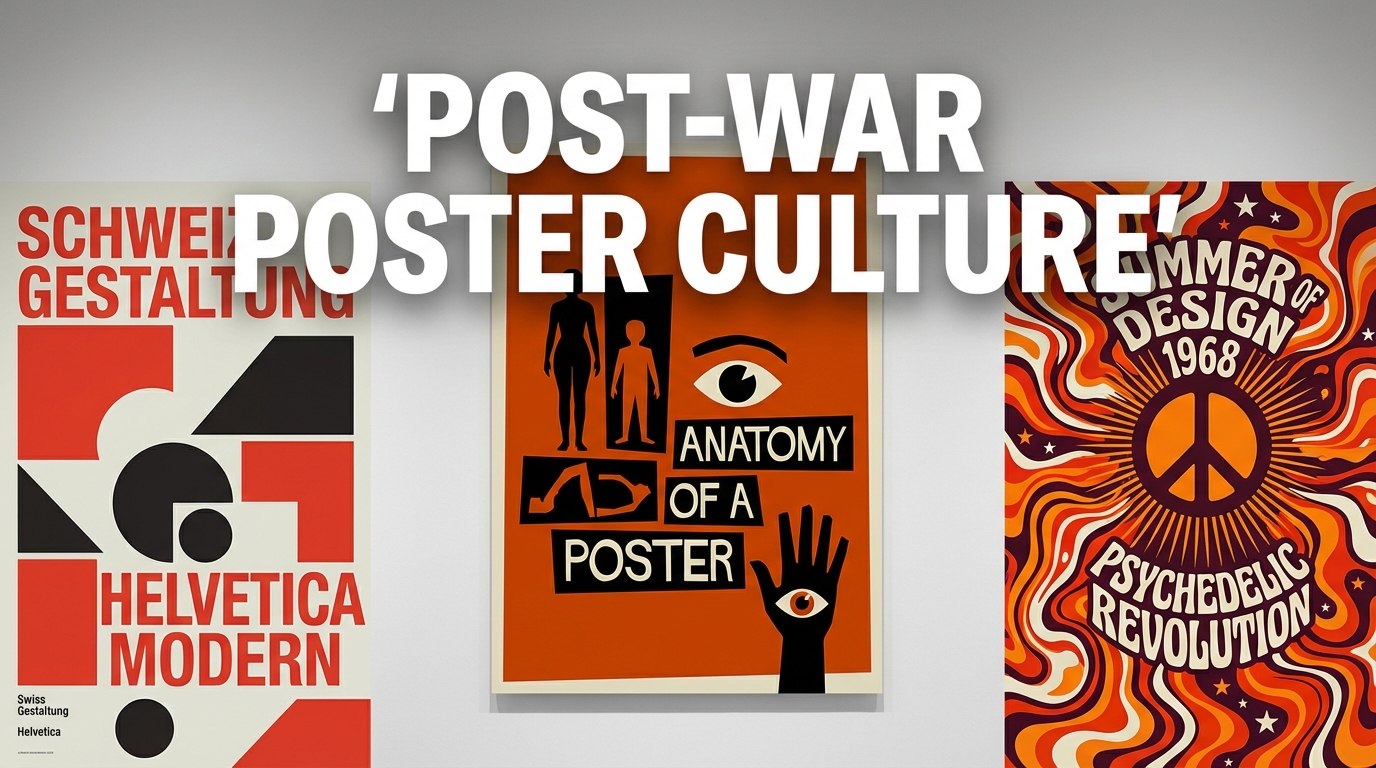
Post-war poster culture represents the radical transformation of graphic design from 1945 through 1979, characterized by four distinct evolutionary phases that mirror broader cultural shifts. The propaganda transition era of the late 1940s saw designers pivot from military mobilization to civilian recovery campaigns, carrying forward the bold composition and persuasive psychology learned during wartime. The 1950s brought modernist precision, as Swiss International Style codified grid systems and sans-serif clarity while Saul Bass revolutionized film marketing with symbolic minimalism. The 1960s exploded into psychedelic experimentation, where concert posters for San Francisco’s Fillmore and Avalon Ballroom merged Art Nouveau curves with counterculture rebellion, while political activists wielded posters as weapons for civil rights and anti-war movements. The 1970s synthesized pop culture and technological fusion, as blockbuster cinema created iconic campaigns and photo-lithography advances enabled photorealistic imagery that coexisted with punk’s anarchic DIY aesthetic. For a deeper look at the artists, history, and design roots from this period, check this movie poster history resource.
What makes this era distinct from previous design periods lies in several converging characteristics. Artistically, post-war posters bridged commercial design and fine art in unprecedented ways. The Swiss International Typographic Style—pioneered by Josef Müller-Brockmann and Armin Hofmann—established mathematical grid systems, asymmetrical balance, and Helvetica’s neutral clarity as foundational principles still taught in design schools today. Simultaneously, the Polish School approached cinema posters as conceptual art rather than mere advertising, with artists like Waldemar Świerzy and Franciszek Starowieyski creating symbolic, often surrealist interpretations that prioritized artistic expression over literal representation. Push Pin Studios in New York, led by Milton Glaser and Seymour Chwast, rejected both Swiss austerity and Polish darkness for eclectic illustration that revived Victorian typography and narrative complexity. These weren’t competing approaches but parallel innovations that expanded what poster design could achieve.
Technically, the era witnessed printing evolution that democratized poster production while maintaining craft quality. Stone lithography’s laborious process gave way to offset printing by the 1950s, enabling mass production of movie posters with consistent color registration and finer detail. Silkscreen printing—embraced by 1960s psychedelic artists—created thick, opaque ink layers that produced vibrant colors impossible with traditional methods, turning limited-run concert posters into tactile art objects. Photo-offset techniques emerged in the late 1970s, introducing photographic halftones that would eventually lead to today’s digital printing. Each method left distinctive markers that collectors now use for authentication: the organic dot patterns of offset lithography versus silkscreen’s solid ink layers versus photo-litho’s fine screens.
The purpose of posters shifted dramatically across these decades, reflecting changing cultural priorities. Where 1940s posters continued wartime’s persuasive mission—promoting war bonds, conservation, and productivity—the 1950s saw posters become consumer advertising tools competing with television’s rise. Film studios invested unprecedented budgets in poster campaigns, recognizing that a single striking image could define a movie’s identity in the public consciousness. The 1960s repurposed posters for cultural promotion and activist messaging, as concert promoters like Bill Graham commissioned weekly designs that became collectible art, while social movements printed protest posters that documented struggles for justice. By the 1970s, blockbuster culture transformed movie posters into merchandising opportunities and cultural phenomena, with designs for Star Wars and Jaws becoming as iconic as the films themselves. For additional exploration of how these themes originated and evolved, see this guide.
Post-war posters also served as real-time cultural documentation in ways that distinguished them from other art forms. A 1943 “We Can Do It!” poster captured women’s wartime workforce participation with immediacy that formal portraiture couldn’t match. Psychedelic concert posters preserved the visual language of counterculture—the swirling lettering, vibrant color clashes, and Art Nouveau references that defined San Francisco’s Summer of Love…
| Era | Dominant Style | Printing Method | Primary Purpose | Collector Focus |
|---|---|---|---|---|
| 1940s | Propaganda Realism, transition from WW2 | Stone lithography, early offset | War mobilization, civilian recovery | Historical, social movements |
| 1950s | Swiss Modernism, Bass minimalism | Offset lithography | Advertising, film marketing | Design innovation, Polish School |
| 1960s | Psychedelic/Pop, conceptual Polish | Silkscreen, offset | Counterculture, activism, cinema art | Movements, protest, concert posters |
| 1970s | Pop, Photorealism, punk DIY | Photo-offset, offset | Blockbuster, rebellion | Icons, sci-fi, underground |
Understanding these defining characteristics equips collectors to navigate the market with informed judgment. For more on the connection between movie poster design innovations and their historical, mid-century roots, see this resource.
The Four Phases of Post-War Design Evolution
Post-war poster design didn’t transform uniformly but evolved through four distinct phases, each responding to specific cultural, economic, and technological contexts.
- 1945–1949: Propaganda Transition
From military propaganda to civilian recovery. Posters focused on economic productivity and reconstruction, often reusing wartime visual strategies. - 1950s: Modernist Innovation
Consumer boom and modernist design (Swiss grids, Helvetica, Saul Bass minimalism), emergence of the conceptual Polish School. - 1960s: Psychedelic/Activist Rebellion
Explosive, tactile silkscreened posters for rock concerts, activist graphics for civil rights, Cuban and Push Pin studio eclecticism. - 1970s: Pop & Photo Fusion
Blockbuster movie posters, photorealism, punk’s low-fi xerox rebellion, and postmodern eclecticism.
If you’re interested in seeing how these phases relate to the legacy of classic movie posters, further reading can be found at this history and design overview.
What Makes Post-War Posters Collectible?
Post-war posters occupy a unique market position—both as commercial ephemera and as fine art. Several factors drive demand and value:
- Historical significance: Posters are primary documents of cultural change, capturing pivotal events and social movements.
- Artistic merit and innovation: Iconic artists (e.g., Saul Bass, Polish School, psychedelic designers) produced museum-worthy works.
- Cultural documentation: Posters chronicle social, musical, and political transformation in real time.
- Scarcity: Most posters were printed for temporary use and are now rare survivors, sometimes with less than 10% remaining.
- Investment potential: Top examples appreciate 8–15% annually, with auction records regularly broken for titles like “Vertigo.”
For the full story behind the collectible value and historic relevance of mid-century movie posters, see this in-depth history.
Essential Authentication Techniques for Beginners
Authenticating vintage posters means systematic, evidence-based examination—every collector can learn these skills:
- Verify the release date: Check actual film or event date. Look for “R” prefix (re-release) on posters, such as “R72/104”. Cross-check with original release info.
- Standard sizes: US one-sheet: 27×41″, Insert: 14×36″, Half-sheet: 22×28″, Window card: 14×22″. Anything else is likely a reproduction.
- Paper quality: 1940s–1970s posters use thicker matte or semi-gloss papers (6–10 pt). Original posters smell musty (lignin breakdown), not fresh or chemical-like.
- NSS codes: For US posters 1940s–1985, check lower right corner. Code shows year and film number (e.g., “58/347” for “Vertigo”).
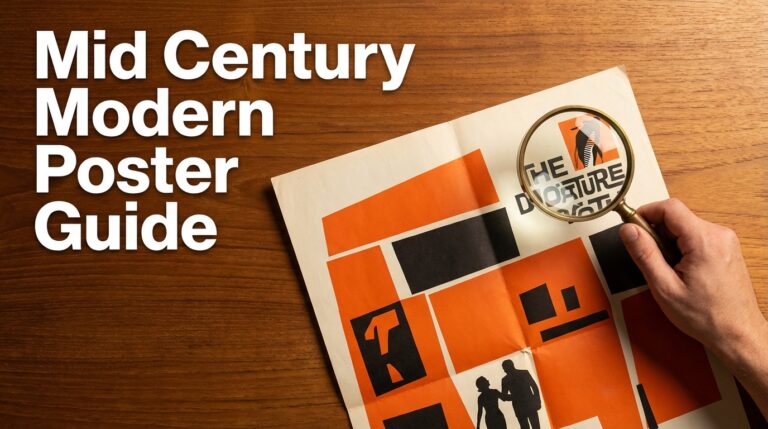
- Print method under magnifier: Offset litho shows organic dot patterns; silkscreen = thick, solid ink layers. Modern (wrong) = perfect grid dots (digital, inkjet, laser).
- Natural aging: Look for consistent yellowing, foxing, edge wear, musty odor—not fake tea-stain or artificially torn reproductions.
- Folds: Most pre-1985 US one-sheets shipped folded. Look for authentic wear along creases. Flat, unfolded = modern, unless advertised as linen-backed.
- Typography and color: Are typefaces period-accurate? Are colors vibrantly subtle, not over-saturated?
- Studio/printer marks: MGM, Warner, Paramount, Globe Poster, etc. Matching marks for era and country.
- Common mistakes to avoid: Don’t buy by “vibe” or “looks old.” Always check measurements, NSS code, material, and compare to images from trusted sources like Heritage Auctions or emovieposter.com.
For more historical context and why these methods matter, see here.
Reading and Understanding NSS Codes
The National Screen Service (NSS) held a monopoly on most U.S. theatrical poster production from the 1940s–1985.
NSS codes are a quick authentication tool:
- Format: YY/NNN — “58/347” is 1958, film #347 (“Vertigo”)
- Re-releases: “R72/104” is a 1972 re-release of film #104
- Location: Lower right corner; should match the film’s actual release year
- Not found: Foreign posters, pre-1940s, after 1985, advance promos
- Always cross-check: Forgeries sometimes include fake codes
| NSS Code | Decoding | Film Example | Verification |
|---|---|---|---|
| 58/347 | 1958 #347 | Vertigo | ✓ |
| 69/260 | 1969 #260 | Easy Rider | ✓ |
| R72/104 | 1972 re-release, orig. #104 | The Graduate | ✓ |
| 77/159 | 1977 #159 | Star Wars | ✓ |
Further context on the NSS system and its legacy: read more.
Paper and Printing Method Identification
Paper character and printing method give crucial authentication clues:
- 1940s: Thick, fibrous matte stocks (8–10 pt); recycled content; stone/offset lithography.
- 1950s–60s: Smoother matte or semi-gloss; organic dot patterns (offset litho), rich colors, 6–8 pt paper.
- Silkscreen (1960s concerts): Super-vibrant colors, thick ink, tactile raised layers—no dot patterns.
- 1970s: Slightly lighter papers (5–7pt), sometimes glossier as photolitho emerges.
- Modern fakes: Uniform/too-perfect dots, ultra-glossy or floppy papers, bright whites, chemical scents.
“Run your hand gently across a Fillmore poster—authentic silkscreen ink is unmistakable. Genuine 1950s offset shows randomness under a 10x loupe—the ‘soul’ digital has never duplicated.”
Hands-on experience sharpens intuition. For richer technical analysis and stories behind these methods, see here.
Advanced Authentication and Collection Strategies
For advanced collectors, authentication is just the start.
Provenance research (auction history, exhibition records, dealer paperwork) increases value and buyer trust. A poster directly sourced from a cinema manager, with photos or documentation, can add a 20–50% premium.
Comparative Authentication: Compare questionable posters to verified museum or auction house examples using high-res scans. Nuances in credit blocks or border layouts reveal fakes.
Chemical/uv analysis: Non-destructive UV reveals natural aging vs. artificial distress. Lignin-based yellowing fluoresces differently than tea-staining.
Strategic Collecting:
- Seek well-documented, high-condition examples of iconic titles.
- Prioritize artists and studios with museum recognition (Bass, Polish School, concert legends).
- Work with reputable galleries and auction houses, always requesting documentation.
- Maintain records (photos, provenance) for your collection—it pays off over time.
“Museum-grade poster collecting is about narrative—knowing not only what you own but the story behind how it survived the decades.”
For more on museum and advanced strategies, see collector guides and history here.
FAQ
What’s the single most important check for authenticity?
Always measure! If dimensions are wrong, it’s almost certainly a reproduction. Then verify NSS code and print method for US posters.
Do re-release (R) codes make a poster less valuable?
Generally yes, but some re-releases (limited, important, or late era) can be rarer than originals and still collectible.
No—condition, title, provenance, and cultural significance matter more than just age. A rare condition “Vertigo” (1958) or Fillmore concert poster may fetch tens of thousands; a damaged, generic title much less.
Can I clean or restore a damaged poster myself?
No. Professional conservation is essential. Amateur cleaning can destroy value instantly—leave repairs, backing, or cleaning to experts only.
Where can I compare authentic poster images online?
Heritage Auctions and emovieposter.com are trusted image archives. Museums like MoMA and Poster House also archive posters with known provenance.
For a deeper dive on all topics, including technical and history background, visit the comprehensive poster resource.