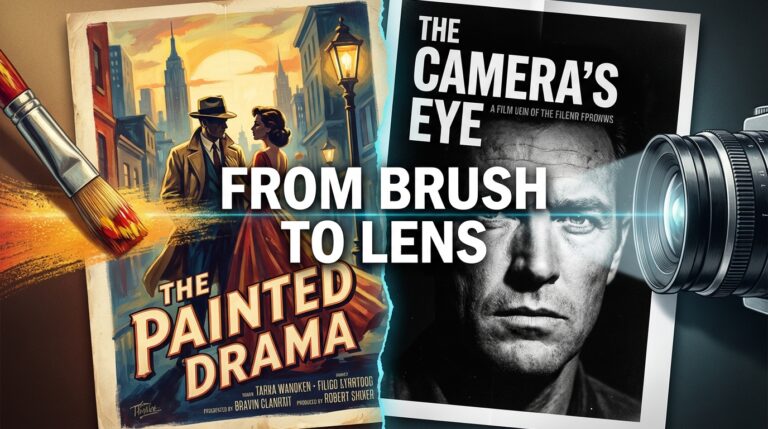
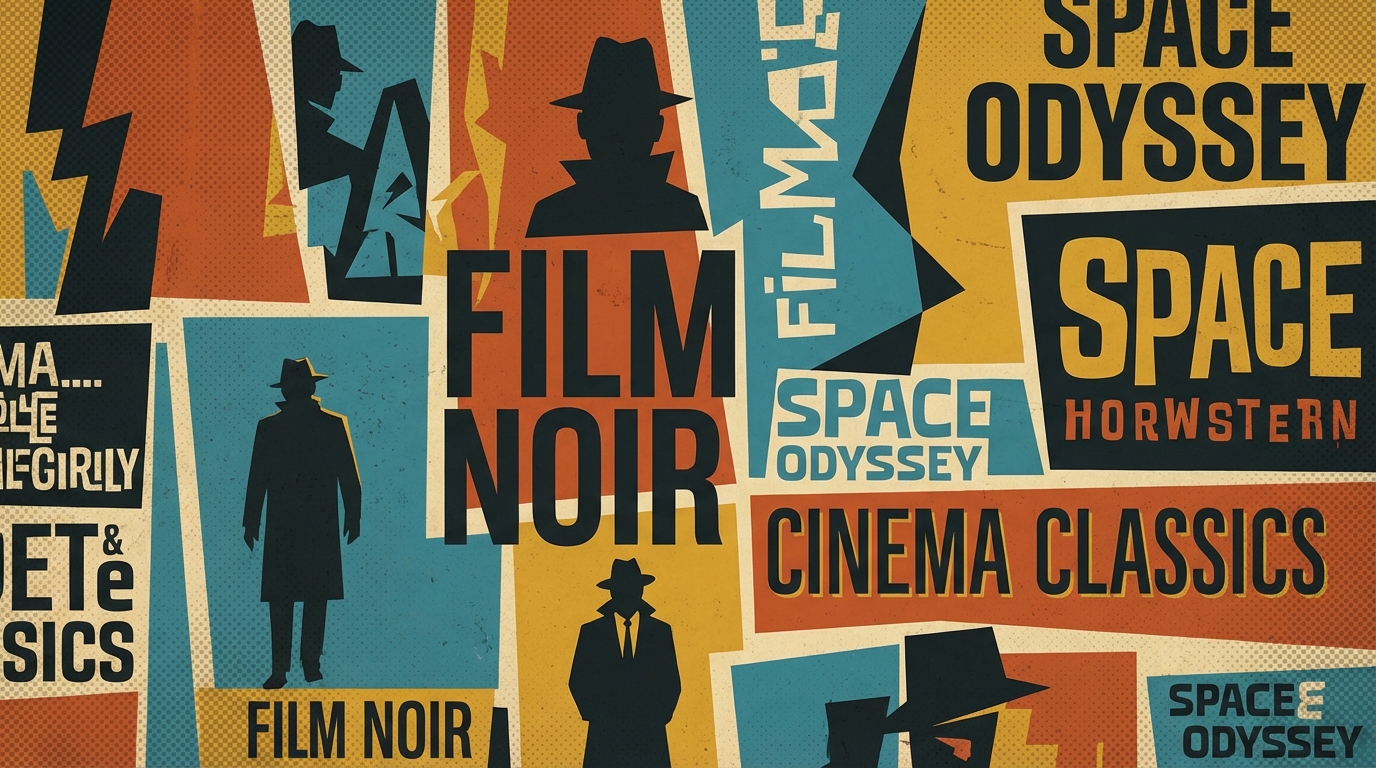
The movie posters that defined the 1940s through 1970s weren’t just promotional materials—they were visual chronicles of cinema’s golden age, designed by skilled illustrators who understood how to distill an entire film into a single, striking image. These mid-century posters combined bold typography, dynamic compositions, and printing techniques that gave them a distinctive look we still recognize and value today. Understanding their origins helps you appreciate why certain design elements work so powerfully in modern interiors and why authentic mid-century poster reproductions carry more visual weight than generic movie prints.
When you hang a well-chosen mid-century movie poster in your living room or home theater, you’re not just adding decoration—you’re connecting your space to a specific moment in design history when illustration, typography, and color theory converged to create some of cinema’s most enduring visual artifacts.
The Historical Origins of Mid-Century Movie Posters
From Early Cinema Posters to the Mid-Century Era
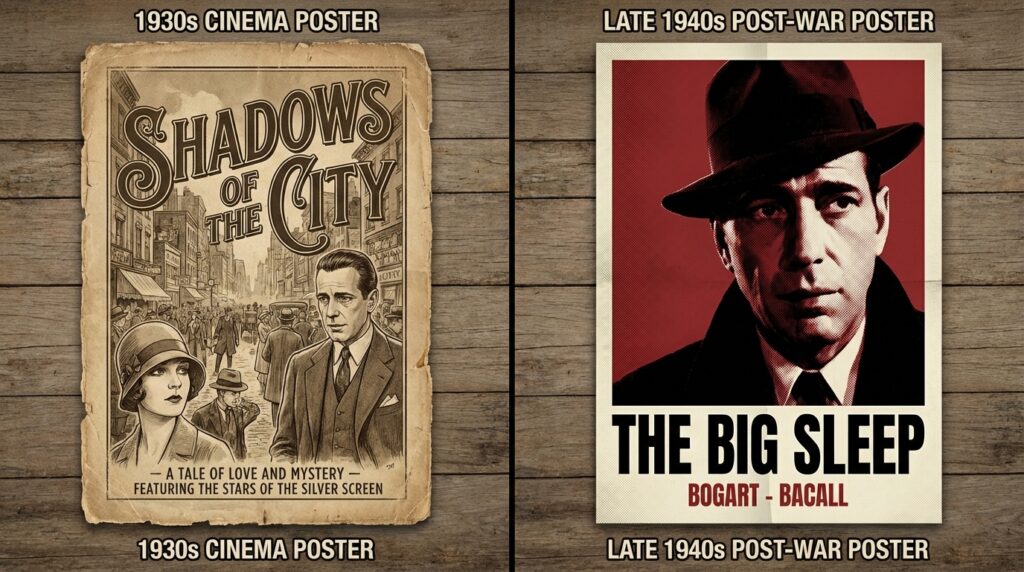
Early cinema posters from the silent era through the 1930s relied heavily on detailed illustration and text-heavy layouts. Studios needed to explain what audiences would see on screen since many films featured unknown actors or unfamiliar stories. These posters typically included multiple illustrated scenes, lengthy plot descriptions, and ornate typography that reflected Victorian and Art Nouveau influences.
The transition to “talkies” in the late 1920s began shifting poster design toward star power and visual drama. By the late 1930s, Hollywood had established a star system, and posters increasingly featured large photographic portraits of actors alongside stylized title treatments. This set the stage for what would become the mid-century aesthetic: cleaner compositions that emphasized visual impact over detailed description, assuming audiences already knew who Humphrey Bogart or Bette Davis were.
Post-War Boom and the Birth of Mid-Century Poster Style
World War II fundamentally altered movie marketing and visual language. During the war years, posters used patriotic imagery and bold graphics that needed to work in reduced color palettes due to material rationing. Designers learned to create maximum impact with minimal elements—a skill that would define post-war poster art.
The post-war boom of the late 1940s brought renewed optimism, expanding cinema audiences, and a generation of graphic designers trained in modernist principles. Studios invested heavily in poster campaigns, and the one-sheet format (27 x 41 inches) became standardized for theatrical display. Poster artists began incorporating techniques from modern advertising: simplified compositions, dramatic color contrasts, and psychologically compelling imagery that conveyed mood and genre at a glance. A film noir poster needed to feel different from a musical, and designers developed visual shorthand—dark shadows and Dutch angles for crime thrillers, bright colors and dancing figures for comedies—that audiences learned to read instantly.
This era also saw the rise of the “concept poster,” where a single powerful image or graphic element represented the film’s theme rather than literally depicting a scene. This approach, combined with advances in offset lithography, gave birth to what we now recognize as the classic mid-century movie poster aesthetic.
Evolution of Film Poster Art Style (1940s–1970s)
From Detailed Illustration to Modern Graphic Expression
The most significant stylistic shift from the 1940s to the 1970s was the move from complex, multi-scene illustrations toward conceptual, graphic-driven designs. Early 1940s posters often crammed in multiple plot points, character portraits, and action scenes, reflecting older theatrical poster traditions. By the 1950s, designers began embracing negative space, focusing on one or two dominant elements that captured the film’s essence.
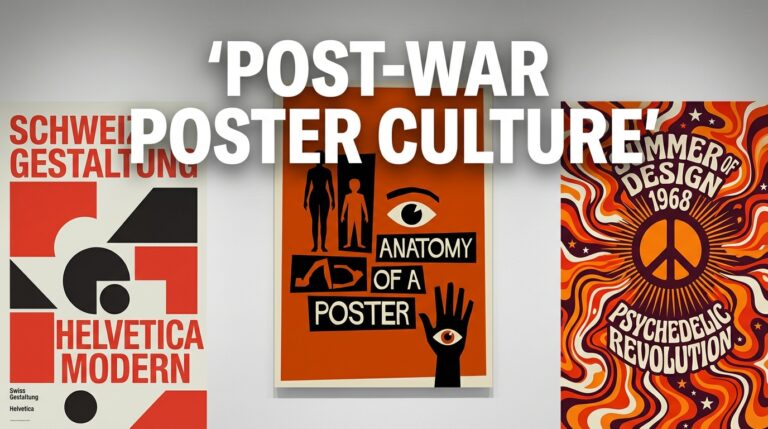
This transition reflected broader changes in graphic design philosophy. European modernism, particularly Swiss International Style and Bauhaus principles, influenced American commercial art. Poster designers started thinking like graphic artists rather than illustrators, using color blocks, geometric shapes, and bold typography to create visual tension. The poster became less about showing what happened in the film and more about evoking how the film would make you feel.
The Look of the 1950s: Iconic Movie Poster Designs
1950s movie posters developed a distinctive visual vocabulary that remains instantly recognizable. Common traits included saturated primary colors (especially red, yellow, and blue), high-contrast compositions, and hand-drawn title lettering that ranged from elegant scripts for romances to bold sans-serifs for action films. Portrait-oriented layouts dominated, with stars’ faces often filling the upper half while dramatic scenes played out below.
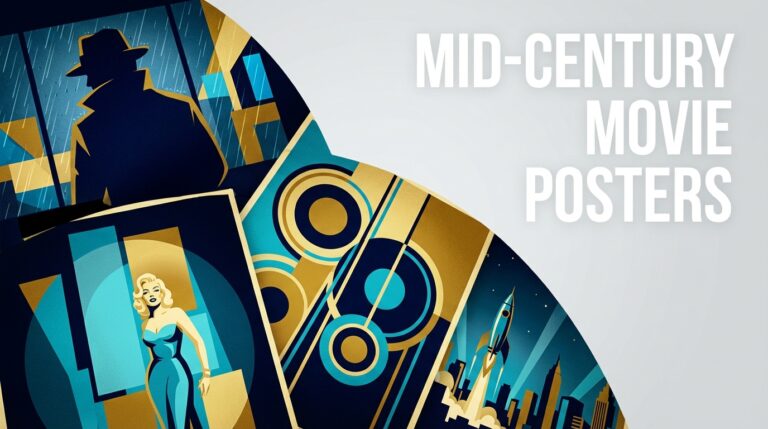
Iconic 1950s poster designs frequently featured the “action pose”—actors caught mid-movement with exaggerated gestures and expressions that telegraphed genre and emotion. Film noir posters of this era perfected the use of shadows and spotlighting, often showing a femme fatale emerging from darkness or a detective silhouetted against city lights. Science fiction posters embraced bright, unrealistic colors—toxic greens, electric blues, and vibrant oranges—to signal otherworldliness. These color choices weren’t just aesthetic; they were strategic decisions rooted in how the posters would look under theater marquee lighting and in shop windows.
The typography of 1950s posters deserves special attention. Title treatments were hand-lettered by specialists, creating unique letterforms that became part of the poster’s artwork rather than just text. This gave each poster a crafted, one-of-a-kind quality that machine-set type couldn’t achieve, and it’s one reason authentic reproductions of these posters feel different from digitally-created modern prints.
Experimentation in the 1960s and 1970s
The 1960s brought cultural upheaval, and movie poster design reflected it. Psychedelic art influenced mainstream poster design, introducing warped typography, saturated color gradients, and surreal imagery. Even major studio releases began incorporating counterculture visual language. Posters for films like Easy Rider or The Graduate abandoned traditional Hollywood glamour shots for more artistic, conceptual approaches that treated the poster as a standalone art object.
By the 1970s, poster design had splintered into multiple streams. Major studio blockbusters sometimes returned to more illustrative, detailed posters (like the iconic Star Wars one-sheet by Tom Jung), while independent and foreign films pushed minimalist and experimental designs. Genre films—particularly horror, blaxploitation, and cult cinema—developed their own visual codes with lurid colors, provocative imagery, and bold claims that bordered on exploitation advertising.
This experimentation made 1970s posters highly diverse and collectible. A single year might produce everything from Drew Struzan’s painterly realism to Saul Bass’s stark minimalism, giving collectors a wide range of authentic mid-century styles to choose from.
Film Noir, Cult Cinema and Genre-Defining Poster Art
The Visual Language of Film Noir Posters
Film noir posters created a visual vocabulary that still defines how we imagine crime thrillers and mysteries. These posters mastered chiaroscuro lighting effects on paper—deep blacks contrasting with stark highlights, diagonal shadows suggesting moral ambiguity, and strategically placed red accents (often in the title or a woman’s dress) that signaled danger and passion.
Typography in noir posters typically used angular, dramatic letterforms that echoed the genre’s themes. Sans-serif fonts with sharp, knife-like edges appeared frequently, as did condensed vertical lettering that created visual tension. Poster artists often positioned text at Dutch angles (tilted off-axis) to create unease and instability, reinforcing the films’ narratives of paranoia and moral compromise.
The composition of noir posters followed specific patterns: the protagonist typically appeared in shadow or silhouette, often with a cigarette or gun; the femme fatale was illuminated, drawing the eye while suggesting her role as both attraction and threat; urban settings—rain-slicked streets, neon signs, venetian blind shadows—established the genre’s distinctive atmosphere. These design choices weren’t arbitrary; they emerged from directors’ and cinematographers’ actual visual techniques, making the posters authentic extensions of the films’ aesthetics.
Cult Cinema Posters of the 1960s
While major studio releases followed certain conventions, cult cinema posters of the 1960s broke every rule. Horror, science fiction, and exploitation films operated on smaller budgets with less oversight, giving poster artists freedom to experiment with shocking imagery, exaggerated claims, and avant-garde design.
Roger Corman’s Edgar Allan Poe adaptations, Hammer Horror films, and American International Pictures releases featured posters that emphasized lurid color, Gothic imagery, and sensational taglines. These posters often promised more than the films delivered, but their artistic ambition and willingness to push boundaries made them highly valued by collectors decades later. A 1960s Italian giallo poster or a Russ Meyer exploitation one-sheet represents design risk-taking that mainstream Hollywood wouldn’t attempt.
What makes these posters particularly interesting from a design perspective is how they merged high art and low culture. Artists trained in commercial illustration applied fine art techniques—surrealism, expressionism, abstract composition—to subject matter considered disreputable. This tension between technical skill and transgressive content gives cult cinema posters their distinctive appeal and their place in mid-century design history.
Key Mid-Century Movie Poster Artists and Designers
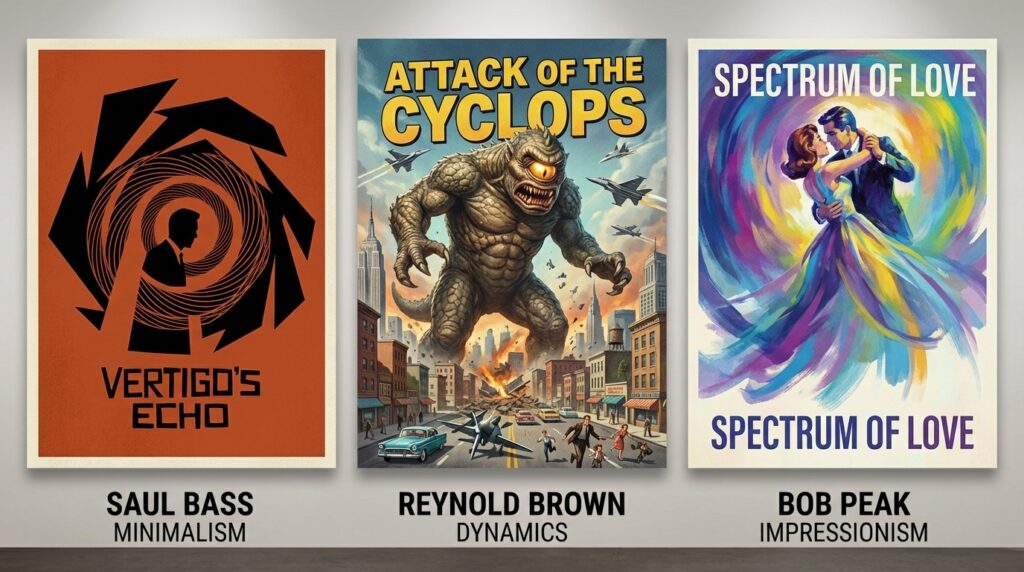
Famous Poster Illustrators of the Classic Cinema Era
Several artists defined mid-century movie poster aesthetics through their distinctive styles and prolific output. Saul Bass revolutionized poster design in the 1950s and 1960s with minimalist, graphic compositions for films like Vertigo, Anatomy of a Murder, and The Man with the Golden Arm. His posters reduced complex narratives to single powerful symbols—a spiral, a fragmented body, an arm—demonstrating that less could indeed be more.
Reynold Brown created some of the era’s most dynamic illustrated posters, particularly for science fiction and adventure films. His work on Attack of the 50 Foot Woman and The Time Machine showcased his ability to render impossible scenarios with convincing drama and technical precision. Brown’s detailed illustration style represented the traditional end of the spectrum, proving that representational art could coexist with modernist approaches.
Bob Peak brought painterly sophistication to movie posters in the 1960s and 1970s, creating impressionistic, loose-brushstroke designs that elevated poster art toward fine art status. His work for West Side Story, My Fair Lady, and Superman showed how expressive color and gestural mark-making could capture a film’s emotional tone without rigid illustration.
International artists also shaped this era. Italian poster designers like Anselmo Ballester and Averardo Ciriello created highly stylized, almost abstract compositions for both Italian productions and American imports, offering alternative visions that influenced worldwide poster design.
How These Artists Shaped Mid-Century Graphic Design
These poster artists didn’t just serve cinema; they advanced graphic design as a discipline. Saul Bass’s emphasis on symbolic imagery influenced corporate logo design and identity systems throughout the 1960s. His approach to integrating type and image as unified compositions became standard practice in advertising and editorial design.
The poster artists’ innovations in color theory—particularly their use of limited but intensely saturated palettes—informed packaging design, magazine layouts, and product advertising. When you see a 1960s appliance ad or record cover with bold blocks of color and minimal text, you’re seeing design principles that movie posters helped popularize.
Perhaps most importantly, these artists established that commercial art could have authorial vision. A Saul Bass poster or a Bob Peak illustration was recognizable across different films, proving that even work-for-hire could carry an artist’s distinctive handwriting. This concept influenced how designers thought about their role, elevating commercial graphic design from anonymous craft to signed art.
Printing Techniques and Materials Behind Mid-Century Posters
Vintage Poster Printing Techniques in the 1950s
Most mid-century movie posters were produced using offset lithography, a printing method that evolved significantly during this period. The process involved photographing artwork, creating color separations (usually four: cyan, magenta, yellow, and black), and transferring each color layer onto printing plates. The plates then transferred ink onto rubber blankets, which pressed the image onto paper sheets.
This method had specific limitations and characteristics that shaped the final look. Color registration—aligning each color layer precisely—was challenging, and slight misalignments created subtle halos or outlines that became part of the mid-century aesthetic. Printers couldn’t reproduce subtle gradations well, so designers worked in flat color areas and hard-edged transitions, which contributed to the graphic, poster-like quality we associate with the era.
Screen printing (silkscreen) was used for limited runs and specialized posters, particularly for art house films and foreign releases. This technique allowed for intense, opaque colors and unique textures but was more labor-intensive than offset printing.
Best Materials for Vintage Movie Poster Prints
Theatrical posters from the 1940s through 1970s were typically printed on relatively thin paper stocks—usually 60 to 100 lb. weight—since they were meant as temporary promotional materials, not permanent art. The paper was often acidic, which means original posters from this era that weren’t stored carefully have yellowed, become brittle, or developed “foxing” (brown age spots).
The inks used were generally petroleum-based, providing vibrant colors that, unfortunately, fade when exposed to sustained light. This is why original posters in mint condition command premium prices; most surviving examples show some degree of color loss or aging.
Modern museum-quality reproductions solve these historical problems by using acid-free, archival papers (typically 200+ gsm weight) and fade-resistant pigment inks. These materials ensure that a reproduction poster will maintain its color and structural integrity for decades, whereas an original poster requires climate-controlled storage and UV-protective framing to prevent further deterioration. For home decor purposes, a high-quality reproduction often provides better long-term results than an affordable but compromised original.
How Printing Techniques Shaped Mid-Century Poster Aesthetics
The technical constraints of mid-century printing directly influenced design choices in ways that now define the era’s style. Because gradual color transitions were difficult, designers embraced flat color fields and sharp contrasts. The limited color palette (usually four to six colors maximum for cost reasons) forced strategic color selection, resulting in those bold, primary-color-dominated posters we recognize immediately as mid-century.
Registration challenges meant that designers often incorporated black outlines around color areas, both to hide slight misalignments and to add graphic punch. These outlines became a stylistic signature of 1950s and 1960s posters, even when printing technology improved enough that they were no longer technically necessary.
The paper’s texture and weight also affected design. Since the paper couldn’t hold extremely fine detail, artists worked in bold shapes and clear silhouettes that would read well even when printed on rougher stock. This pushed design toward simplified, iconic imagery—the very quality that makes mid-century posters work so effectively in modern interiors, where they need to hold attention without overwhelming a space.
Original vs Reproduction: What Survives from the Origins
Original vs Reprint Vintage Film Posters
An “original” theatrical poster was printed for a film’s initial release and distributed to theaters for display. These posters were working promotional materials, not intended as collectibles. Studios printed them in quantities based on expected distribution—a major release might have 10,000+ copies, while a limited release might have only a few hundred. After the theatrical run, most posters were discarded or destroyed, though some were sent back to studios for re-releases.
A “reprint” was created later, sometimes by the studio for a re-release, sometimes by commercial poster companies, and sometimes by unauthorized printers. Legitimate reprints from the 1960s and 1970s can themselves now be valuable, while later commercial reprints generally have collector value only if they’re high-quality, limited editions.
The confusion arises because there’s no central registry of what’s “original” versus what’s a reprint, especially for films from smaller studios or international releases. Collectors rely on physical evidence, knowledge of printing practices, and provenance documentation to determine authenticity.
Difference Between Original and Reproduction Movie Posters
Several physical characteristics help distinguish original theatrical posters from later reproductions. Original posters typically have specific dimensions (27 x 41 inches for US one-sheets, though international formats varied), fold lines from storage and shipping, and printer marks or union stamps along the edges. The paper weight, texture, and aging characteristics provide additional clues.
Reproductions, even high-quality ones, usually show different paper characteristics, printing methods, and size variations. Modern digital printing creates dot patterns different from offset lithography, though advanced giclée printing can closely approximate vintage printing quality. The key difference for most buyers isn’t age or method but intent and quality: Is this a carefully produced artwork that respects the original design, or is it a cheap novelty print with poor color matching and low resolution?
For home decor purposes, a museum-quality reproduction often serves better than an affordable but damaged original. A reproduction printed on archival paper with accurate color matching and proper sizing will look significantly better on your wall than a compromised original with fading, tears, or foxing—and it won’t require expensive conservation framing.
Museum-Quality Vintage Movie Prints Today
Advances in digital imaging and printing technology now allow for reproductions that capture the visual impact of original posters while improving on their durability and accessibility. Museum-quality prints use high-resolution scans of original posters (or, when available, original pre-press artwork) to recreate the design’s every detail, then print using archival pigment inks on acid-free paper that won’t yellow or deteriorate.
The best reproduction prints don’t try to fake age or damage; instead, they present the poster as it would have appeared on opening night in 1955 or 1967—vibrant, intact, and ready to make an impact. This approach makes sense for home decorators who want the authentic mid-century aesthetic without the fragility and expense of collecting original theatrical materials.
Choosing museum-quality reproductions is appropriate when you’re focused on how the poster looks and functions in your space rather than on owning a specific historical artifact. For building a gallery wall in your living room or creating period atmosphere in a home theater, a curated selection of high-quality prints offers better visual consistency and longevity than a random collection of original posters in varying conditions.
Authenticity, Provenance and Collectibility Rooted in the Origins
How to Identify Authentic Vintage Posters
Authenticating vintage posters requires examining multiple physical characteristics. Start with size: most US theatrical one-sheets measured 27 x 41 inches from the 1940s through the 1980s, though some special formats existed. International posters used different dimensions—Italian “locandinas” were typically 13 x 28 inches, while British quads measured 30 x 40 inches.
Check the paper’s texture and weight. Original theatrical posters used relatively thin paper that shows distinct aging patterns: slight yellowing, subtle brittleness, and sometimes “offset” (when a folded poster’s ink transfers to the facing surface). Modern reproductions on thick, bright-white paper immediately signal non-original status.
Fold lines are crucial indicators. Original posters were almost always shipped to theaters folded (usually into quarters or eighths), creating permanent creases. A “rolled” original poster (never folded) is extremely rare for films before the 1980s and commands premium prices. If someone claims a 1950s poster is an original but it shows no fold lines, be skeptical.
Look for printer identification, union stamps, or National Screen Service (NSS) markings along the poster’s borders. NSS handled distribution for most major studios from the 1940s through 1984, and their date codes and stamps provide authentication. However, the absence of such markings doesn’t automatically mean a poster is fake—some studios handled their own printing, and international versions followed different systems.
The most common mistake beginners make is assuming age equals authenticity. A poster can be genuinely old (a 1970s reprint, for instance) without being an original theatrical release item. Understanding the specific film’s release history and poster variations requires research into film-specific references and collector guides.
Provenance and Authenticity of Vintage Film Posters
Provenance—documented history of ownership and origin—significantly impacts both value and confidence in authenticity. A poster that comes with documentation showing it was obtained directly from a theater in the 1950s, or from a film studio archive, carries more credibility and value than one with unknown history.
Typical provenance documentation might include: original theater records or correspondence, studio distribution paperwork, letters from previous collectors, auction house certificates, or authentication from recognized experts in movie poster collecting. Photographs showing the poster in historical context (displayed in a theater lobby, for example) add supporting evidence.
However, most surviving theatrical posters have no formal provenance simply because they weren’t considered valuable when new. A poster might have hung in a theater, been taken home by an employee, stored in an attic for decades, and surfaced at an estate sale with no paperwork. Lack of provenance doesn’t make such posters fake, but it means authentication relies more heavily on physical examination and knowledge of printing practices.
Why Original 1950s Movie Poster Art Is So Collectible
Original 1950s posters command high prices and passionate collector interest for several interconnected reasons. First, cultural nostalgia: the 1950s represent Hollywood’s golden age in popular imagination, and the films themselves remain widely watched and referenced. A poster for Rear Window or Rebel Without a Cause connects to stories and stars that continue resonating across generations.
Second, scarcity: theatrical posters were disposable promotional materials, and most were destroyed after use. Studios didn’t archive them systematically, and theaters discarded them when films finished their runs. Survival rates for 1950s posters are low, and posters for certain films or in certain conditions are genuinely rare.
Third, design quality: the 1950s produced some of cinema’s most striking and innovative poster art. The combination of skilled illustrators, bold graphic approaches, and distinctive printing aesthetics created posters that work as standalone art objects beyond their promotional function.
Finally, crossover appeal: mid-century movie posters interest multiple collector communities—film historians, graphic design enthusiasts, mid-century modern decorators, and pop culture collectors—creating broader demand than purely cinema-focused collectibles might generate.
This intersection of historical importance, visual appeal, and scarcity drives the collectible market and explains why even museum-quality reproductions of these designs remain valuable for people who appreciate the artwork without needing to own historical artifacts.
From Historical Origins to Home Decor and Modern Collections
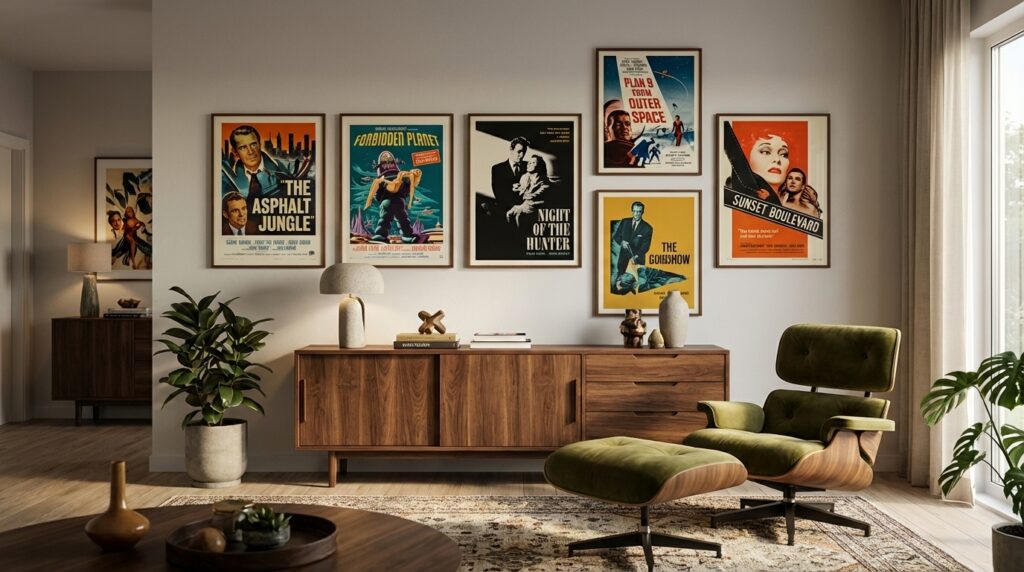
Mid-Century Movie Posters as Mid-Century Modern Wall Art
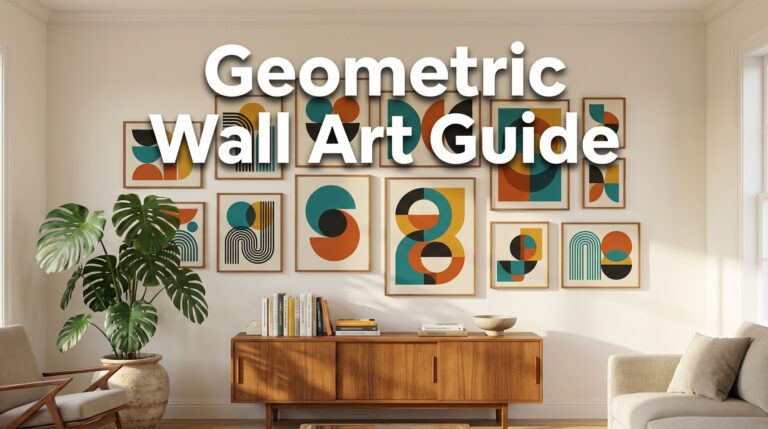
The natural pairing of mid-century movie posters with mid-century modern interiors isn’t coincidental—both emerged from the same design philosophy and historical moment. The clean lines, organic forms, and functional elegance of mid-century furniture find visual echoes in the simplified compositions, bold graphics, and purposeful design of posters from the same era.
Color coordination is particularly effective: the burnt oranges, teal blues, warm yellows, and olive greens common in mid-century posters complement the wood tones and period color schemes of Eames chairs, teak sideboards, and Danish modern furniture. A film noir poster’s dramatic black-and-white composition can anchor a room with neutral tones, while a 1960s psychedelic poster adds controlled visual energy to a space with subdued furnishings.
Typography matters too. The hand-lettered title treatments and modernist sans-serif fonts on mid-century posters share design DNA with period signage, product packaging, and interior graphics. A well-chosen poster doesn’t just depict mid-century style; it literally embodies it through authentic typographic and compositional choices from the era.
Vintage Hollywood Poster Collections for Home Decor
Building a cohesive poster collection requires thinking curatorially about themes, visual connections, and narrative flow. A gallery wall organized by decade tells a visual story of evolving design—1940s noir sophistication flowing into 1950s optimism and then 1960s experimentation. This chronological approach helps visitors understand cinema and design history through your walls.
Genre-based collections offer another compelling approach. A grouping of film noir posters creates a moody, sophisticated atmosphere perfect for a home office or library, with their dark palettes and dramatic typography establishing a consistent mood. Science fiction posters from the 1950s and 1960s, with their bright colors and imaginative imagery, work beautifully in creative spaces, game rooms, or modern living areas.
Director or actor-focused collections provide narrative cohesion. Grouping posters from Alfred Hitchcock films or showcasing the evolution of Audrey Hepburn’s image across her career creates a viewing experience that’s about more than individual artworks—it becomes a visual essay on a creative figure’s impact.
The key to successful curated walls is balancing variety with coherence. Mix different sizes and formats within your theme, but maintain color harmony and stylistic connection. Don’t hang every poster in identical frames; vary frame styles and widths while keeping a consistent color family (all black, all natural wood, all metallic finishes) to avoid visual chaos.
Framed Vintage Movie Posters for Modern Homes and Home Theaters
Framing choices can honor the poster’s historical character while fitting contemporary interiors. For authentic mid-century aesthetics, consider thin metal frames in black, brass, or aluminum, which echo period architectural details. Simple wood frames in walnut, teak, or birch tones reference mid-century furniture without competing with the poster’s graphics.
Home theaters present special opportunities for poster display. Since these rooms explicitly celebrate cinema, you can create immersive environments with multiple posters that might overwhelm a living room. Consider grouping posters by genre to reinforce the room’s purpose—classic Hollywood musicals for a light-hearted vibe, or suspense thrillers for a more dramatic atmosphere.
Lighting matters significantly. Theatrical posters were designed to be visible under marquee lights and lobby fixtures, so they respond well to focused picture lighting or track lighting. However, use LED lights that don’t emit UV radiation or heat, which can damage paper and fade inks over time, especially with original vintage posters.
Scale is critical: a poster that’s too small for a large wall appears tentative and lost, while an oversized poster can overwhelm a cozy space. The standard 27 x 41-inch one-sheet format works well above furniture pieces like sideboards, sofas, or beds. For larger walls, consider grouping multiple posters or using wider formats like three-sheets or Italian two-foglios.
Where to Find Curated Mid-Century Movie Posters Today
Curated Sources for Authentic and Reproduction Mid-Century Posters
Finding high-quality mid-century posters requires knowing where to look and how to evaluate sources. Vintage poster galleries and specialized dealers offer original theatrical posters with authentication and provenance, though prices can reach thousands of dollars for sought-after titles in good condition. Auction houses occasionally feature movie poster sales, particularly Heritage Auctions and Christie’s, which attract serious collectors and establish market values.
For museum-quality reproductions and prints, specialized online retailers that focus on curated selections offer significant advantages over generic print-on-demand sites. Curated sources employ experts who understand poster history, reproduction quality, and proper sizing. They select designs based on historical importance and visual impact, filtering out the countless low-quality or inappropriately sized prints that flood the market.
The value of curation can’t be overstated when you’re building a home collection. A curated source ensures you’re getting accurate color reproduction, appropriate paper quality, and designs that represent authentic mid-century aesthetics rather than later commercial reprints or unauthorized derivatives. This matters because poor-quality prints with muddy colors or pixelated details will disappoint once they’re on your wall, regardless of how inexpensive they were to purchase.
For a carefully curated selection of classic mid-century movie posters that honor the original designs while providing modern archival quality, explore our Sadesuihkusetit at Retro Vintage Posters.
Limited Edition Classic Movie Posters for Collectors
Limited edition reproductions occupy an interesting middle ground between mass-market prints and original theatrical posters. These are typically high-quality prints produced in controlled quantities (often 100-500 copies), sometimes signed or numbered by contemporary poster artists, and printed using superior techniques and materials.
Collectors choose limited editions when original posters are prohibitively expensive or unavailable, or when they want the design’s visual impact without the fragility and conservation requirements of vintage paper. A limited edition print on archival paper can hang in a sunny room or high-traffic area where an original would require protective framing and careful placement.
Some contemporary poster artists and galleries commission new artwork based on classic films, creating what’s essentially a new “edition” of a film’s poster art. These artist-driven limited editions blend mid-century inspiration with contemporary illustration techniques, offering fresh interpretations while honoring historical design principles.
How Mid-Century Poster Art Continues to Influence Design and Culture
How Mid-Century Poster Art Influenced Interior Design
The influence of mid-century movie posters extends well beyond cinema history into broader interior design practices. The bold color blocking, dramatic typography, and simplified compositions that defined poster art informed textile patterns, wallpaper designs, and decorative accessories throughout the 1950s and 1960s. This cross-pollination continued as mid-century modern style experienced major revivals in the 1990s and 2010s.
Contemporary interior designers reference mid-century poster aesthetics when creating “period-appropriate” spaces or when seeking bold graphic elements that provide focal points without overwhelming modern minimalist environments. The posters’ ability to deliver strong visual statements through limited means—a few colors, clear shapes, dynamic type—aligns perfectly with contemporary design preferences for impact without clutter.
Furniture and product designers continue mining mid-century poster art for color palettes and graphic motifs. The specific shades of orange, teal, yellow, and olive that appear in 1950s and 1960s posters now inform everything from throw pillows to coffee table books, creating visual continuity across decades.
Why the Origins Still Matter to Collectors and Design Lovers
Understanding the origins and history of mid-century movie posters enhances both collecting and decorating practices. When you know why a poster looks the way it does—the printing limitations, the artist’s intentions, the genre conventions, the cultural moment—you make more informed choices about which posters will work in your specific spaces and collections.
The origins matter because they provide authenticity and depth. A poster chosen because you understand its historical context and design innovation carries more meaning than one selected solely because “it looks cool.” This knowledge helps you avoid common mistakes: buying poorly reproduced designs that don’t capture the original’s visual impact, choosing posters that clash with your actual decor style, or misunderstanding what you’re purchasing (thinking a recent reprint is a valuable original, for instance).
For collectors, understanding origins is fundamental to building meaningful collections that tell coherent stories about cinema history, design evolution, or artistic achievement. For home decorators, this knowledge ensures your poster selections genuinely reflect mid-century aesthetics rather than generic vintage pastiche.
From Origins to Your Own Mid-Century Poster Collection
The journey from Hollywood’s golden age to your living room wall connects multiple threads: artistic innovation by talented illustrators, printing technologies that shaped visual style, genre conventions that created visual languages, and the enduring appeal of cinema’s most creative period. A well-chosen mid-century movie poster isn’t just nostalgic decoration—it’s a tangible link to this rich design and cultural history.
Whether you’re a serious collector pursuing original theatrical posters or a home decorator seeking museum-quality reproductions that capture authentic mid-century aesthetics, understanding these origins helps you make choices you’ll appreciate for years. The posters that successfully survived from the 1940s through 1970s did so because their designs transcended mere promotion to become genuine art objects—striking, memorable, and visually sophisticated.
As you build your own collection, remember that the best mid-century posters work because they balance bold visual impact with design restraint, dramatic imagery with clean composition, and genre expectations with artistic innovation. These same principles should guide your selection and display choices, ensuring your walls reflect the confident, optimistic, and visually dynamic spirit of cinema’s most stylish era.
Explore curated selections that honor this design legacy, pay attention to reproduction quality and proper sizing, and trust your eye while informing it with knowledge about what made these posters matter in the first place. The result will be a collection that doesn’t just decorate your space but genuinely connects it to one of the twentieth century’s most visually rich artistic movements.