Ultimate Guide To Mid-Century Modern Wall Decoration (2026)
Estimated reading time: 18 minutes
A single authenticated 1958 Saul Bass movie poster can transform a minimalist living room from generic to gallery-worthy—that’s the transformative power of authentic mid-century modern wall decoration. In 2026, as interior design circles increasingly reject mass-produced décor in favor of historically significant pieces, understanding what constitutes genuine mid-century modern aesthetics separates collectors who build appreciation-worthy spaces from those who simply fill walls.
This comprehensive guide provides design enthusiasts, homeowners, and collectors with expert knowledge spanning MCM definitions, authentication techniques, sourcing strategies, and advanced styling methods. You’ll learn to identify period-accurate design elements, distinguish investment-grade pieces from generic reproductions, apply professional installation techniques, and curate cohesive collections that honor the 1945-1970 modernist movement.
Whether you’re decorating your first mid-century-inspired space or refining an established collection, these insights will help you make informed decisions about poster sizing, color coordination, gallery wall composition, and strategic purchasing that builds both aesthetic and financial value over time.
Key Takeaways
- Authenticity matters: Original mid-century modern wall art from 1945-1970 holds both design and investment value.
- Distinct visual language: Geometric shapes, bold colors, and functional composition define MCM style.
- Careful sourcing: Learn to authenticate materials and printing methods to avoid costly reproductions.
- Display techniques are key: Proper installation ensures longevity and visual impact.
- Gallery walls: Advanced composition and balance elevate group displays beyond single statement pieces.
- Investment potential: Quality MCM pieces have demonstrated consistent appreciation, making them financial assets as well as décor.
Table of Contents
- What Is Mid-Century Modern Wall Decoration?
- Historical Context – The Golden Age (1945-1970)
- Essential Elements Of Authentic MCM Wall Art
- Recognizing Quality Vs. Mass-Market Reproductions
- Types Of Mid-Century Modern Wall Decoration (By Category)
- Tools And Supplies For MCM Wall Installation
- Basic Techniques For Displaying MCM Wall Art
- Advanced Styling Techniques For MCM Gallery Walls
- FAQ
What Is Mid-Century Modern Wall Decoration? (Definition & Core Concepts)
Mid-century modern wall decoration encompasses artwork, sculptural pieces, and decorative objects created between 1945-1970 (sometimes up to 1975), characterized by clean geometric lines, organic biomorphic shapes, bold limited color palettes, simplified illustration, and a functional design philosophy prioritizing clarity over embellishment. This movement emerged post-World War II, synthesizing Bauhaus principles, Scandinavian minimalism, and distinctly American modernist optimism.
Visual characteristics: geometric abstraction (simplified shapes), organic forms inspired by nature, asymmetrical composition, limited color palettes (mustard yellow, teal blue, burnt orange, avocado green + neutrals), and bold sans-serif typography. These elements create designs that communicate instantly and clearly—modernist tenets of “form follows function” and “less is more.”
Key influencers: Charles and Ray Eames, George Nelson, Saul Bass, Alexander Girard, and Josef Müller-Brockmann each helped shape the movement toward democratized, accessible design.
MCM wall decoration remains culturally relevant in 2026 because its timeless aesthetic and historical significance merge perfectly with the current authenticity and sustainability trends. Pieces from 1945-1970 appreciate both visually and financially, resonating with today’s values.
For a deeper dive into how the movie poster art of the era exemplified these design values, see mid-century movie posters history & design.
Historical Context – The Golden Age (1945-1970)
The MCM movement evolved in three distinct phases reflecting broader technological and cultural shifts:
- Post-War Era (1945-1955): Bauhaus meets American optimism. Use of new materials; poster art featured bold geometric compositions and Swiss-influenced typography.
- Atomic Age (1955-1965): Space race motifs, atomic starbursts, and experimental colors—teal, chartreuse, orange—modern abstraction at its peak.
- Late Period (1965-1970): Psychedelic influences, Op Art, transition toward postmodernism, rich diversity especially in international posters.
Explore a detailed timeline in post-war poster culture guide and WWII to Hollywood’s Golden Age.
Essential Elements Of Authentic MCM Wall Art
Authentic MCM wall art is defined by era-specific production techniques, materials, and clear historic provenance. Understanding these authentication markers helps safeguard investments and build collections of genuine value, not just stylish décor.
- Original vintage pieces: movie posters (one-sheets, inserts, half-sheets, lobby cards) must have period NSS dating codes, union printer marks, specific paper stocks, and size specs.
- Geometric and abstract art: Bauhaus and Swiss-inspired, authentic serigraphs show organic dot patterns (stone litho), hand signatures, limited color, dynamic grid compositions.
- Three-dimensional wall sculptures: metal starbursts (hand-welded, natural patina), authentic period wood carvings (teak, walnut), signed ceramic wall pieces.
- Textile and fiber art: Alexander Girard’s textiles, Marimekko/Day screen prints, hand-woven natural fiber wall hangings, period-saturated color palettes.
For curated authentic and reproduction wall art, browse Sadesuihkusetit.
Recognizing Quality Vs. Mass-Market Reproductions
Paper and material: Vintage poster paper ages naturally (warm cream tones, fiber content visible at torn edges), is slightly brittle at the edges; modern stock is bright white, smooth, often glossy. Backlight tests reveal fiber irregularities.
Printing methods: Lithography produces random dot patterns; period offset printing shows subtle color registration; digital prints are uniform grid dots with no tactile ink texture. Examine with a jeweler’s loupe for clues.
Color characteristics: Period inks age and fade gracefully; reproductions often oversaturate, use artificial staining, or show unnatural uniform “vintage” effects.
Size matters: Vintage theatrical posters are standard—27×41 inches, 14×36, 22×28, 11×14—modern prints use frame-friendly sizes. Deviation flags a reproduction.
Price/source: Originals command hundreds to thousands, sold by specialist auctions/dealers; mass-market reproductions are $15-$50, found via home décor chains.
For insights on the brush-to-lens transition, see from brush to lens: movie posters.
Types Of Mid-Century Modern Wall Decoration (By Category)
Explore category evolution and collecting at mid-century movie posters history & design.
Movie Posters & Film Art (1940s-1970s)
Quintessential MCM wall art, movie posters synthesize graphic innovation with mass appeal; their commercial origins become cultural icons. Film noir: high contrast, diagonal composition, bold type, minimalist palettes. Saul Bass’s designs revolutionized the field, infusing geometric abstraction with emotional narrative.
- Film noir classics (1950s): Dramatic, psychological, visually simple but powerful.
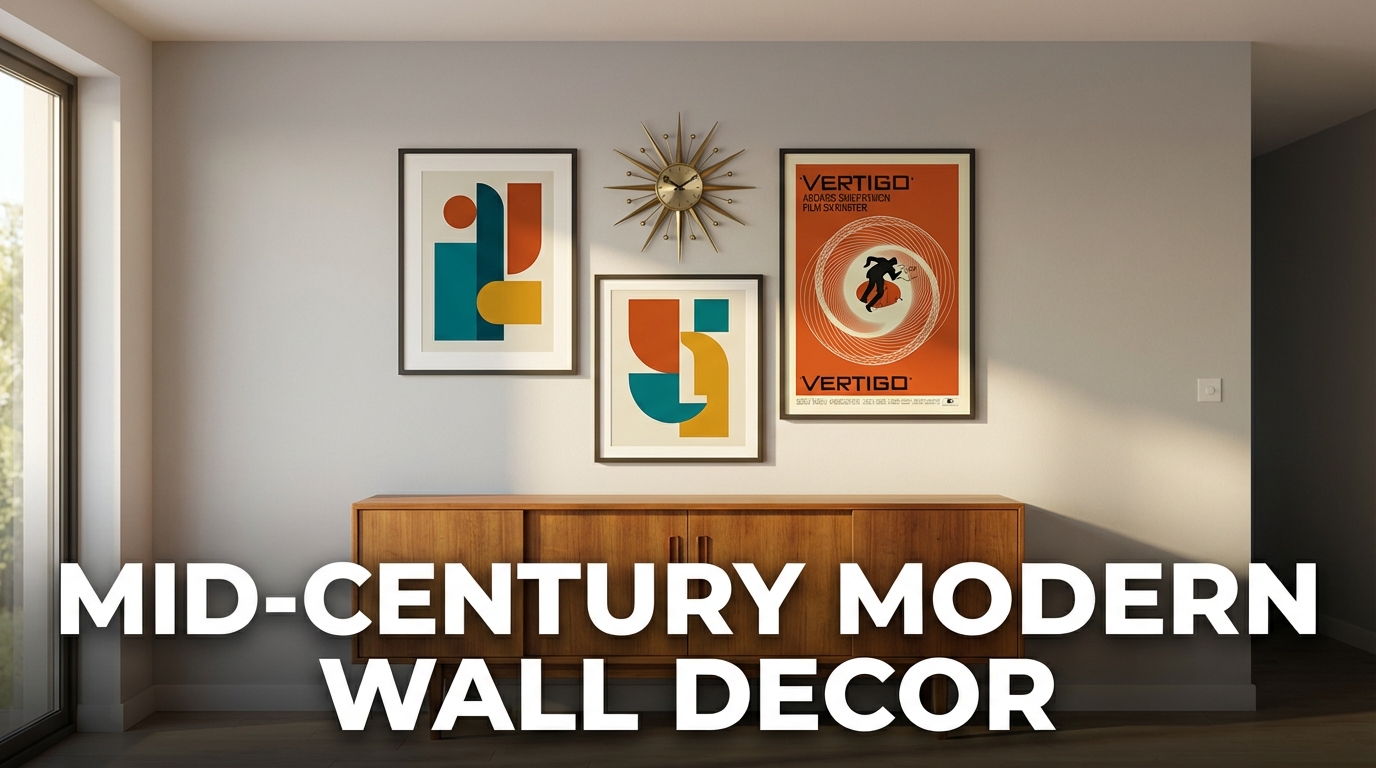
- Saul Bass era (1955-1965): Geometric reduction; “Vertigo”, “Anatomy of a Murder”.
- International variants: French, Italian, Polish posters bring design diversity at accessible prices.
- Genre classics: Sci-fi, Hitchcock thrillers, lesser-known modernist jewels.
- Condition & grading: Value hinges on C-scale grading and restoration (linen-backing).
For further history and techniques, explore Hollywood Golden Age and Brush to Lens Transformation.
Find authentic and reproduction examples at T-Shirts.
Geometric & Abstract Prints
Bauhaus and Swiss influences manifest as grid composition, saturated color, intentional minimalism. Charley Harper’s wildlife abstracts distill nature to bold geometric shapes, appreciated for timeless clarity. Josef Müller-Brockmann concert posters exemplify information hierarchy and grid mastery; original works are rare, but museum-quality reproductions are accessible.
Abstract expressionist prints bring color-driven, emotional variety. When collecting, seek works with purposeful color harmony, intentional negative space—not arbitrary decoration.
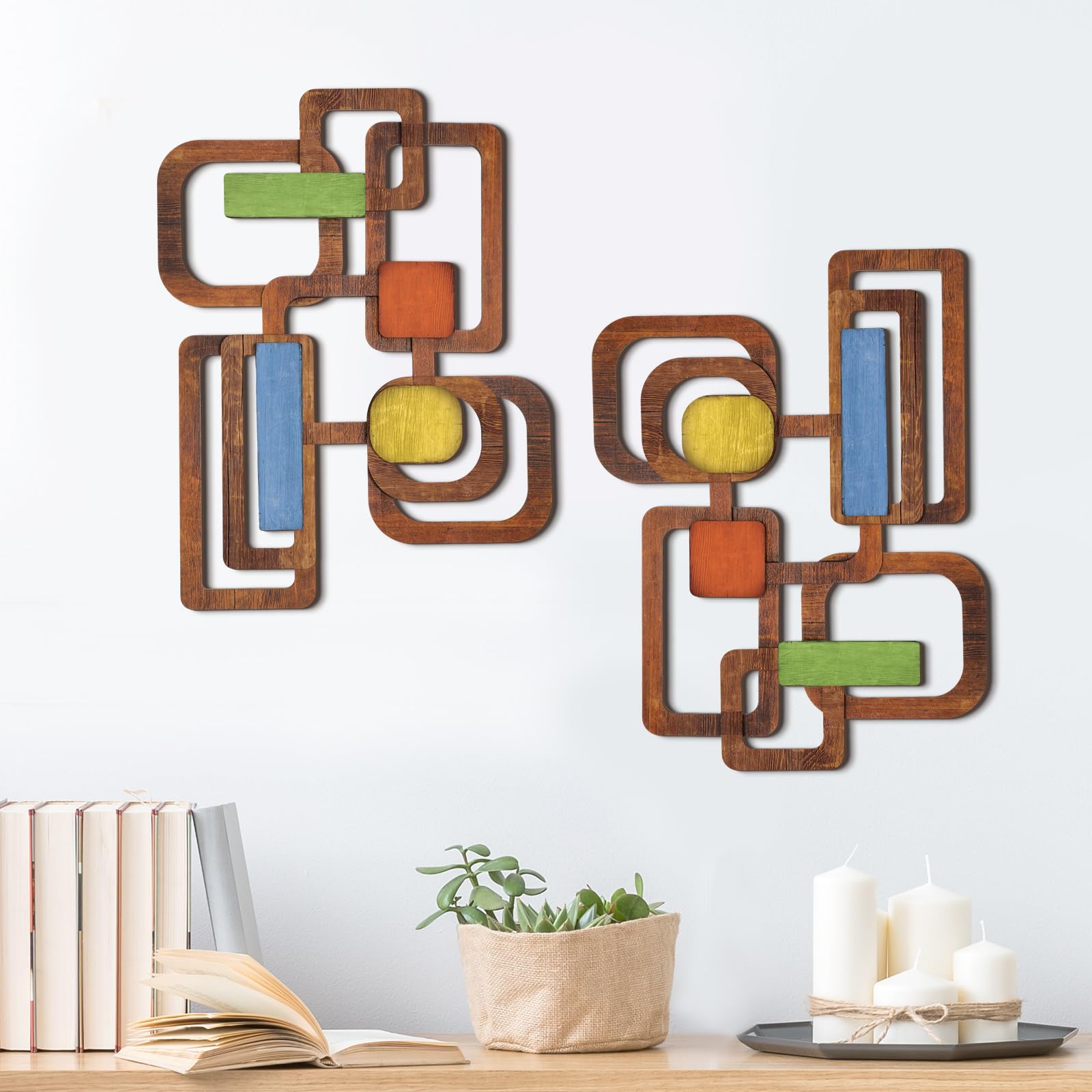
Three-Dimensional Wall Sculptures
Metal starbursts deliver atomic age optimism in brass, copper, steel; Curtis Jeré signed pieces are premium. Wood reliefs from Witco introduce tiki-modern motifs, integrating hand-carving with MCM simplicity. Ceramic wall art—Bitossi, Rosenthal-Netter, Marshall Studios—adds colorful organic dimension. Display layered sculpture with flat framed art for professional effect.
Textile & Fiber Wall Art
Textiles add softness, acoustic benefits, and color variation. Girard’s Environmental Enrichment Panels and Marimekko graphic prints epitomize MCM’s integration of abstract pattern with utility. Macramé (properly colored and sized) works as a warm accent. Tip: Use custom stretched textile panels for seasonal flexibility.
Functional Wall Decor (Clocks, Shelves, Planters)
George Nelson clocks symbolize MCM’s union of sculpture and utility; authenticate by manufacturer and material. Floating shelves (String system, Nelson/Eames designs) showcase collectables and create gallery layering. Wall-mounted planters (ceramic, metal, wood) bring organic elements and vibrant color to often-neglected vertical spaces.
Tools And Supplies For MCM Wall Installation
- Hanging hardware: Laser level, stud finder, tape measure, picture wire, wall anchors rated for object weight.
- Preservation/framing: UV-protective glass/acrylic, acid-free mats, mounting corners/tapes, conservation wax for wood frames. Linen-backing for vintage posters.
- Layout planning: Paper templates, painter’s tape, center-point measurements.
- Maintenance: Microfiber cloths, approved cleaners, archival sleeves for unframed storage.
Basic Techniques For Displaying MCM Wall Art (Beginner’s Guide)
- Wall selection & height: 57-60 inches from floor to art center (museum standard). Above furniture: 6-8 inch clearance, width 2/3-3/4 furniture.
- Lighting: White/neutral backgrounds, indirect natural light, LED picture lights or track lighting.
- Single statement piece: Calculate height, mark, use right anchor, check level.
- Diptych/triptych: 2-3 inch spacing, align edges, use identical frames, calculate total width pre-hang.
- Avoid mistakes: Too high, weak anchors, mismatched frames, wrong scale.
Advanced Styling Techniques For MCM Gallery Walls
Gallery walls require planning with brown paper templates and careful compositional thinking. Photograph arrangements before installing for reference. Try these layouts:
- Symmetrical grid: Uniform rows and columns, strong order.
- Horizontal line: Cohesive above furniture pieces.
- Salon style: Asymmetrical, variable spacing, visually organic.
- Diagonal rise: Stairs, hallways, upward visual movement.
- Frame-within-frame: Negative space shapes unify multiple pieces.
Visual cohesion: Restrict color to 3-4 dominant hues, match frames, vary sizes and visual weight, maintain uniform spacing. Integrate dimensional objects—floating shelves, starbursts—for layered effect. Apply the 60/40 rule, ensuring negative space frames your art. Echo gallery colors in room accents.
FAQ
How do I verify my movie poster is authentic?
Check for NSS dating codes, period printer marks, precise size specs (e.g., 27×41 inches for one-sheets), paper color and fiber content, and, if possible, the provenance from reputable dealers. Examine printing technique under magnification for lithographic dot randomness and ink texture.
What makes MCM wall art different from mass-market “retro” décor?
True mid-century modern art was crafted by designers rooted in Bauhaus, Swiss rationalism, and postwar optimism, using period materials and methods. Mass-market décor copies the style visually but lacks historical context, quality, and investment value.
Where can I buy authentic MCM wall art online?
Start with trusted auction houses and specialist dealers, and curated collections like Lattiakaivot Ja Kaivonkannet. Review each piece’s provenance, size, printing method, and guarantee before purchase.
What is the best way to display a gallery wall without damaging originals?
Use acid-free matting, UV-protective glass, linen-backing for fragile posters, and proper anchors. Employ the brown paper template method for layout and install with safety-rated hardware, minimizing holes and handling. Keep art away from direct sunlight and humidity sources.
Can I mix originals with reproduction pieces on one wall?
Yes! Use reproductions as filler or thematic accent, but let authenticated originals anchor the arrangement. Maintain consistency in framing and spacing for visual unity.
Do MCM pieces appreciate in value?
Authenticated MCM wall art, especially one-of-a-kind or designer pieces (e.g., Saul Bass posters, Curtis Jeré sculpture), has historically risen in value, seeing 5-15% annual gains for high-quality examples. Proper care and provenance tracking are crucial.