From War to Hollywood’s Golden Age: The History of Mid-Century Movie Posters (1940s–1970s)
Estimated reading time: 18 minutes
- Mid-century movie posters (1940s–1970s) transitioned from disposable ads to collectible design icons representing Hollywood’s golden age.
- Learn to spot originals by analyzing paper quality, printing technique (stone litho/offset), size standards, and NSS codes.
- The 1940s–1970s saw styles shift: wartime minimalism (1940s), modernist geometry and star power (1950s-60s), bold/blockbuster graphics (1970s).
- Rarity, condition (the C1–C10 scale), and content (star, director, genre, designer) all drive value—prices range $150 to $50,000+.
- Anyone can start collecting with $300–$500, focusing on later-era posters to learn authentication and condition factors.
- Themed collections (director, genre, designer) create deeper enjoyment and long-term investment opportunities.
What Defines Mid-Century Movie Posters? (Era, Style & Historical Context)
Mid-century movie posters are theatrical promotional prints created between 1940 and 1979 for cinema exhibition, distributed primarily through the National Screen Service (NSS) to American theaters. These posters served a singular purpose: drawing audiences into movie houses during Hollywood’s most prolific decades. Unlike modern reproductions, authentic mid-century posters were working advertisements printed on specific paper stocks, using period-appropriate techniques like stone lithography (1940s–1950s) and offset printing (1960s–1970s).
The historical context shapes every aspect. For a deep dive into the visual story, see the mid-century movie posters history & design guide.
Three distinct periods define mid-century poster art:
- 1940s: Wartime minimalism (driven by paper rationing), then post-war colorful escapism.
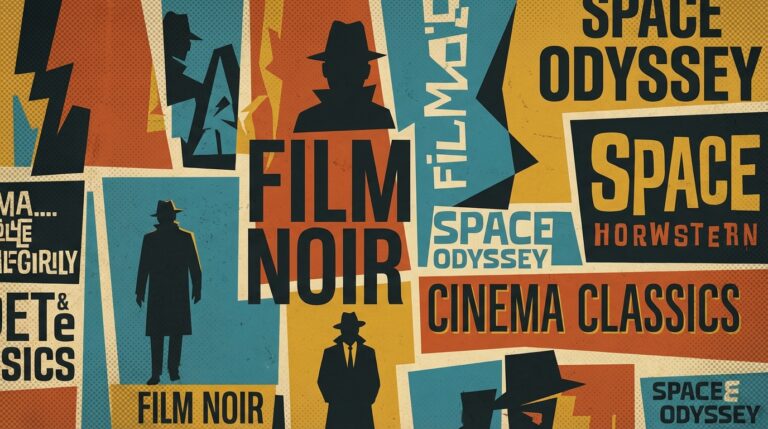
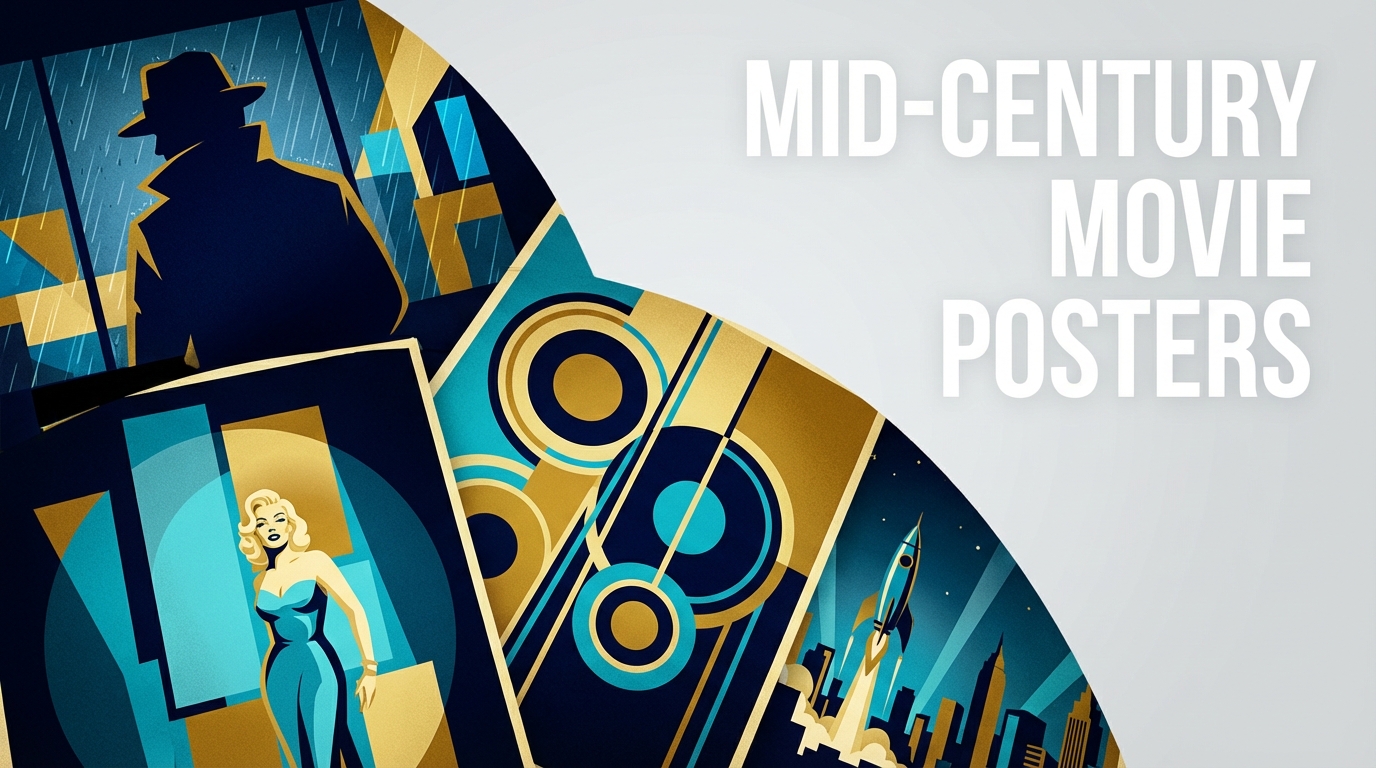
- 1950s–60s: Modernist geometry, clean lines, vibrant limited-color palettes, star power layouts—designers like Saul Bass & Reynold Brown rule.
- 1970s: Bold typography, early photo usage, marketing for the blockbuster era, memorable icons like the Jaws shark.
Authentic one-sheets measured 27×41 inches, with other regular sizes for inserts, half-sheets, and window cards—knowing these helps spot originals.
| Decade | Design Characteristics | Key Genres | Rarity & Value Factors |
|---|---|---|---|
| 1940s | Wartime minimalism, post-war color, stone lithography | Noir, musicals, melodramas, comedies | Extremely rare, $2,000–$50,000+ |
| 1950s–60s | Modern geometry, color, star portraits, Swiss influence | Horror, sci-fi, musicals, westerns | Most collectible, $500–$15,000 |
| 1970s | Bold type, photos, blockbuster branding | Blockbusters, auteur cinema | Title-dependent, $150–$8,000 |
The 1940s—From Wartime Austerity To Colorful Escapism
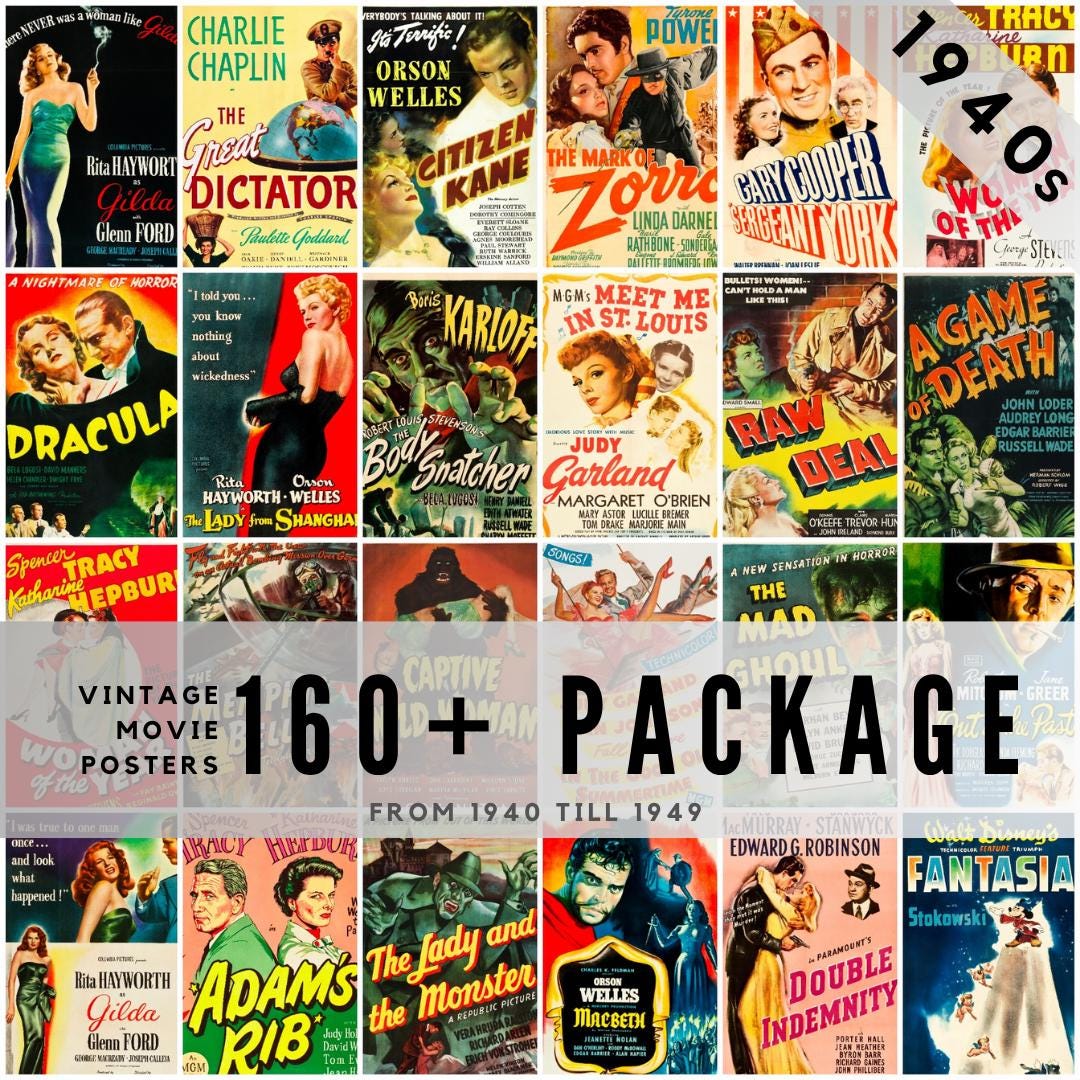
World War II paper rationing (1942–1945) made posters simpler: text, single-color print, hand-drawn lithography. After 1945, color and fantasy return. *The Red Shoes* (1948) and *His Girl Friday* (1940) visibly mark the shift from austerity to optimism.
Rarity defines survivor values—a C7 *Casablanca* one-sheet sold for $42,000 in 2020. Even minor film noir posters command several thousand dollars if authentic.
Want a collector’s guide to the wild postwar years? Visit the post-war poster culture guide.
The 1950s-1960s—Mid-Century Modern Meets Hollywood Glamour
Posters in these decades are instantly recognizable for their confident modern lines, minimalism, and creative color. Saul Bass reduces entire films to singular shapes (the Vertigo spiral, The Man with the Golden Arm’s cut-out), while stars like Marilyn Monroe and Audrey Hepburn glow in iconic portraits. Technical evolution (offset printing post-1960) expands possibilities and accessible surviving supply.
The 1970s—Blockbusters, Bold Type & The End Of An Era
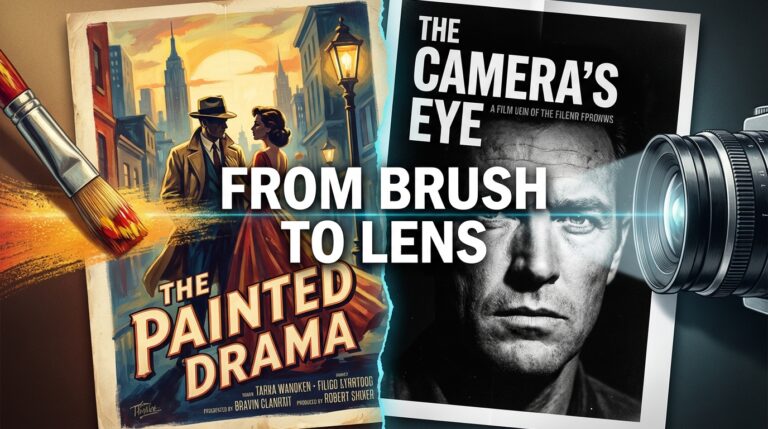
The blockbuster age means bold, photographic emphasis: Jaws, The Godfather, and Star Wars steer the visual identity to directness and recognizability. It marks the end of the hand-painted tradition as cost and speed become key.
How To Identify Authentic Mid-Century Posters (Authentication & Key Markers)
Anyone can call a poster “vintage” online, but authentic collectors need to examine paper, ink, size, and codes. Literally, “feel” and “see” your way past fakes.
Modern reproductions use glossy photo paper or inkjet processes; real 1940s–70s posters always show the character of age. Elite authentication means being able to answer: Is the paper right? Do folds/fibers/pinholes fit with the history?
For an illustrated walk-through of visual impact and printing legacy, check out the mid-century design story.
Paper, Printing & Physical Characteristics
- Matte to semi-matte paper, thicker and “woollier” to the touch—never ultrabright white or shiny like modern posters.
- Lithography (1940s-50s): random dot/texture under magnification, sometimes slight color misalignments; ink is tactile, has “presence.”
- Offset (1960s–70s): uniform dot pattern, thinner ink than litho. Still, the ink never looks “flat” or pixelated as with digital prints.
- Edges age, yellow, or tan; tiny brown “foxing” spots are good aging, *not* flaws in history’s eyes.
- Concerned about fakes? If the paper is shiny, fiberless, or the print looks pixelated/machine-perfect—you’re likely holding a reproduction.
Your Quick Authentication Checklist:
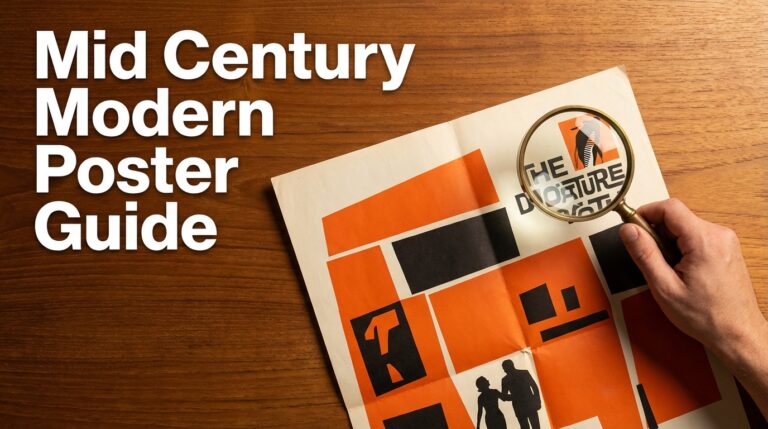
- Visible paper fibers (10x magnifier preferred), not glossy
- Some edge yellowing, evenness of color and age appropriate to the decade
- Ink should be rich in color and have depth (not “laser” blue or “neon” pink)
- Folds in logical places—most originals were folded for shipping, except a few flat-shipped rarities or reissues.
- Correct era size: one-sheet is 27×41″ (69x104cm), not the modern 24×36″ art print size
Size Standards, NSS Codes & Dating Systems
- One-sheet (27×41″) = the main poster seen in most lobby displays
- Insert (14×36″), half-sheet (22×28″), window card (14×22″)
- NSS codes in margins: e.g., “58/347” = 1958, film #347. Not always present, but strong evidence of originality
- Printer’s mark, union bug, or studio copyright notices support authenticity
| Format | Standard Size | Use | Collectibility |
|---|---|---|---|
| One-Sheet | 27×41″ | Lobby display | Most common, strong value |
| Insert | 14×36″ | Vertical showcase | Scarcer, 30–50% premium |
| Half-Sheet | 22×28″ | Lobby (horizontal) | Steady demand |
| Window Card | 14×22″ | For stamping showtimes | Highly collectible |
Fold Patterns & Condition Indicators
- Most mid-century posters have standard folds as mailed to theaters; unfolded “mint” posters are extreme rarities (and often reissues).
- Pinholes (from tacking), especially in corners, are usually a good sign—proof the piece actually hung in a theater.
- Minor edge tears, border tanning: natural and desirable. Over-restoration, trimmed edges, heavy tape lowers value and desirability.
- Linen-backing by professionals is acceptable; undisclosed or amateur restoration is a red flag.
What Determines The Value Of Mid-Century Movie Posters?
Value rests on three pillars: rarity, condition, and content.
- Rarity: Driven by survival rate from original print runs. WWII-era posters? Outright scarce (under 10% survive), so five-figure results are common for classics.
- Condition: The industry uses a C1–C10 scale. C8–C10 posters are prized and display beautifully. Even a two-grade improvement (say, C5 to C7) can double or triple a piece’s auction value.
- Content: Some genres (noir, horror, sci-fi) and stars (Monroe, Dean, Bogart) drive premiums. Iconic designers like Saul Bass can multiply value nearly tenfold for the same title. Cult status and crossover collectible genres (sci-fi, film noir) magnify demand.
Rarity Factors—What Makes A Poster Scarce?
- Posters from 1940–45: WWII paper drives destroyed 85–95% of prints. Surviving one-sheets routinely bring $2,000–$50,000 depending on title/star.
- 1950s–60s: Higher survival, but still only 5–10% of print run lasting. Entry-level pieces $500+, premium titles $10,000+.
- 1970s: Bigger print runs and collecting culture preserved more, so most titles sell for $150–$600 unless blockbuster/cult status kicks in (then $1,000–$8,000).
- Smaller formats like inserts, half-sheets, and window cards were printed at 10–15% of one-sheet runs, making them 30-60% more valuable for top titles.
Condition Grading—The C1 To C10 Scale Explained
- C10 Mint: Unused, pristine, no folds/marks. Almost *never* seen in original 1940s–60s pieces outside archives—5–7x value premium.
- C8–C9: Near-mint w/ only folds, or one barely visible mark—2–4x value premium, highly collectible.
- C7: Displayable wear: some corner creasing, fold separation up to 1/4″, minor border wear.
- C6: Noticeable use, several pinholes/tears, some tape on the verso. Most originals from theaters will grade here (0.8–1x base value).
- C3-C5: Heavy damage (tears, stains, tape, loss): values drop to 30–70% of baseline.
Example: Vertigo (1958) one-sheet by Saul Bass:
- C9: $22,000–$26,000
- C8: $14,000–$18,000
- C6–C7: $5,000–$10,000
- C3–C5: $800–$4,000
Star Power, Genre & Design—Content Value Drivers
- Monroe, Dean, Bogart, and Hepburn posters command 2x–5x premiums over “common” stars.
- Hitchcock (especially Saul Bass-designed), Kubrick, Welles films fetch highest multiples.
- Noir, horror, and sci-fi genres appeal to cross-collectors—values rise 1.5x–2.5x accordingly.
- Designer works (Saul Bass, Reynold Brown): +300%–800% above baseline for known pieces.
| Factor | Value Multiplier | Examples |
|---|---|---|
| Top Stars | 2–5x | Monroe, Dean, Bogart |
| Director Auteurs | 1.5–4x | Hitchcock, Kubrick |
| Designer Credit | 3–8x | Saul Bass |
“A perfect storm: 1958 Saul Bass-designed Hitchcock poster, C9 condition—$20,000–$35,000 at auction.”
How To Start Collecting Mid-Century Movie Posters (Beginner’s Guide)
Ready to start? Begin small: buy a $300–$500 poster as your first “teaching tool.” Focus on a favorite genre/era (often 1960s–70s, as these are less likely to be faked and are affordable).
For a step-by-step how-to and additional history, see the collecting guide.
Starting Small—The $500 First Purchase Strategy
- Allocate $300–$500 for a first purchase (choose a title you’ll enjoy seeing on the wall!)
- Favor 1960s or 1970s one-sheets (good survival rates, clear authentication signs)
- Buy from reputable dealers or established auctioneers—avoid ambiguous Etsy/eBay/Craigslist listings for your first buy
- Examine paper, folds, NSS code, ask for photos of every angle and the back—your “tuition” in authentication
- Professionally frame for display (improper DIY mounting can irreversibly hurt value!)
- Recommended entry posters ($300–$500, C7+):
- The Sound of Music (1965) – musical classic
- Bullitt (1968) – Steve McQueen, iconic car graphics
- Planet of the Apes (1968) – sci-fi staple
- The Great Escape (1963) – McQueen ensemble
- 1970s blockbusters/disaster: The Poseidon Adventure, The Towering Inferno, Earthquake
Caution:
“Original” Hitchcock or Monroe posters for $50 are never real. Always check size, authentication marks, and demand clear answers/photos from sellers. If it feels too cheap, it is probably not authentic.
Building Themed Collections (Intermediate Approach)
Once you’ve examined a few originals and learned the basics, upgrade: choose a theme (director, genre, studio, designer, star). This focus will build deeper knowledge, increase display appeal, and streamline the hunt.
- Director sets: Hitchcock’s US releases (approx. 23 posters); Kubrick’s works; “all the Bond posters.”
- Genre runs: Sci-fi 1950s B-movies; Universal horror; all musicals from the 1960s.
- Stars: Monroe, Grant, McQueen, Dean “career” wall collections. If you love Bogart, collecting his noir posters is an endlessly rewarding project.
- Designer retrospectives: Saul Bass (1950s–70s); Reynold Brown (“monster art”).
| Theme | Typical Budget |
|---|---|
| Film Noir (15 pieces, C7+) | $25k–$60k |
| Hitchcock Complete US Set (23 posters, C6+) | $80k–$150k |
| Universal 50s Sci-Fi (10 key titles) | $20k–$45k |
| Marilyn Monroe Retrospective (20 posters) | $60k–$120k |
| Saul Bass Designs (10 posters) | $60k–$120k |
Designer and theme research allows you to recognize underpriced gems and network with specialist dealers who can alert you to rarities when they surface.
Where To Buy—Trusted Sources Versus Red Flags
- Heritage Auctions: The gold standard for top-tier originals, especially $3,000+ posters. 20–25% buyer premium, but grades and provenance are trustworthy.
- Specialty galleries: Posteritati (NYC), Movie Poster Archives, Film Art Gallery—higher prices, but authentication is included, and return policies exist.
- Established eBay sellers: Good for mid-range and entry collections, especially if feedback is substantial and return policies are clear. Always demand size, code, and back photos before purchase.
- Avoid: Unclear “vintage-style” Etsy, Craigslist, and social media poster sellers for investment purchases. Fakes are rampant; buy only for décor, not for value.
“Collect what you love. Authentication adds protection. Over time, even a $400 poster you treasure can become a $2,000 heirloom.”
FAQ
How do I know if my movie poster is an original or a reproduction?
Check the paper (matte, visible fibers), printing dots (random or regular dots, not perfect pixel grids), and era-accurate size. Look for NSS codes in the margins. Most original mid-century posters also have fold lines and pinholes. Modern-looking, glossy, perfectly white, or printed-to-the-edge posters are usually recent reproductions.
Why do some posters from the same movie vary so much in value?
Rarity and condition drive value more than title alone. A C9, one-sheet first release is always worth the most. Reissues, foreign versions, and damaged or trimmed copies command much less. Star, genre, and designer multipliers also matter—star posters or Saul Bass designs fetch vast premiums versus more generic artwork for the same film.
Is collecting movie posters a good investment?
The best pieces (iconic titles, great condition, star power, designer credit) have consistently appreciated. But start with what you love—the guarantee is enjoyment, with investment-grade potential if you master authentication and market trends. Entry-level posters are primarily for décor and learning, not profit.
Where can I learn more about posters, authentication, and artists of the era?
Explore specialist dealers and resources such as the Mid-Century Movie Posters History & Design Guide and Post-War Poster Culture Guide. Heritage Auctions (HA.com) offers archives and auction results for price and grade research.
Is fold-free a problem? Should I buy only unfolded posters?
Most originals were delivered folded; folds are not considered damage by collectors for posters prior to the 1980s. An unfolded (“rolled”) 1950s–60s poster can be a rarity, but if seen too often, it may be a modern reproduction or a reissue. Original fold lines, minor pinholes, and edge wear are honest and expected.