From Brush to Lens: How Illustration Gave Way to Photography in Mid-Century Movie Posters
Estimated reading time: 17 minutes
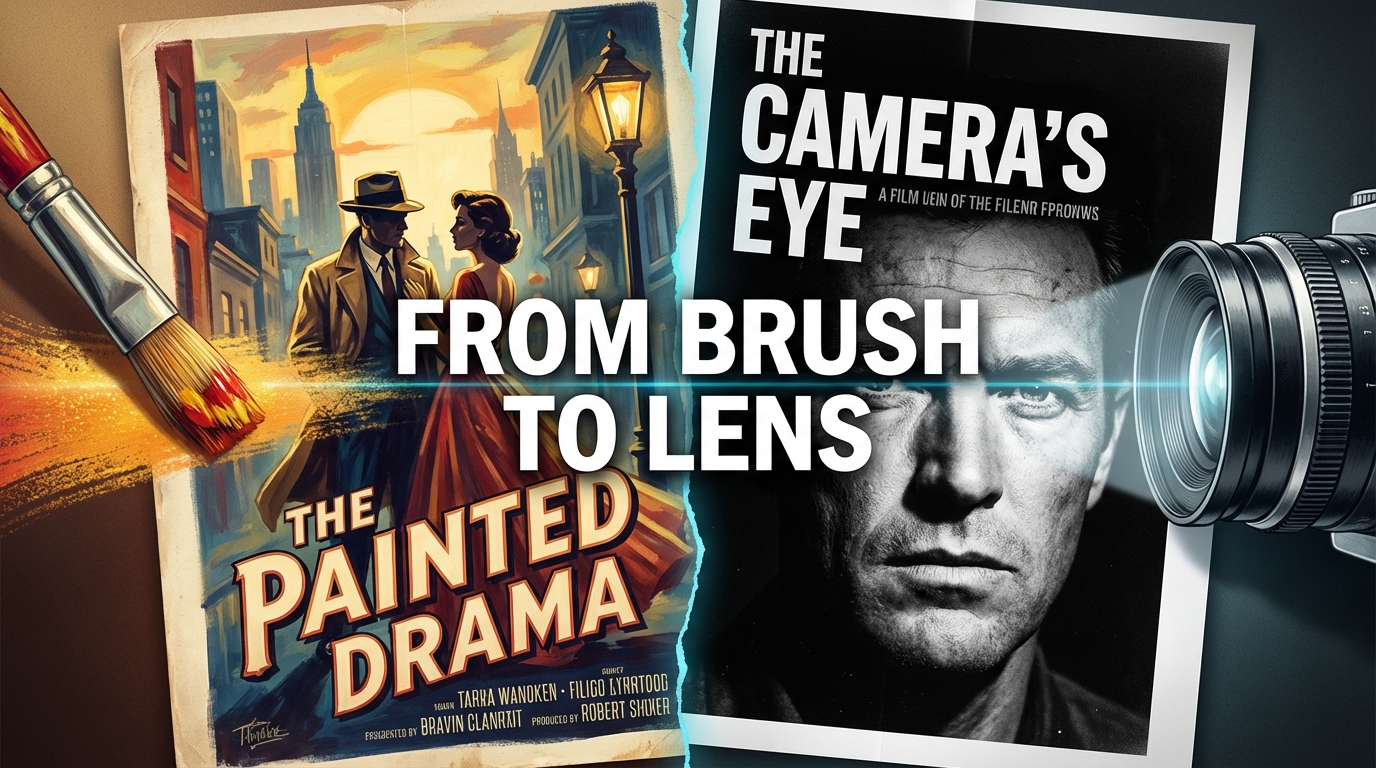
- Mid-century movie posters underwent a dramatic shift from hand-painted illustration (1930s-1950s) to photographic imagery (1960s-1970s).
- Advances in printing technology, economic pressures on studios, and changing audience expectations fueled the transition.
- Collectors value both styles, but understanding tools, techniques, and historical context helps identify authentic pieces and assess value.
- Notable artists like Saul Bass and Drew Struzan bridged both eras with hybrid techniques.
- Every poster reveals the double narrative of its film and the design evolution of its time.
Table of Contents:
- What Defined the Transition From Illustration to Photography in Movie Posters?
- How Mid-Century Poster Artists Created Illustrated Movie Posters
- Advanced Photography Techniques That Transformed Poster Design
- Essential Tools and Materials That Defined Both Artistic Eras
- Why the Shift Happened: Technology, Economics, and Cultural Forces
- Collecting Posters From Both Artistic Eras: What to Know
- FAQ: Common Questions About Illustrated vs. Photographic Movie Posters
- Conclusion
Picture a classic 1940s movie poster. Casablanca, perhaps. A painted embrace, Lauren Bacall’s face rendered in dreamy airbrushed perfection, dramatic typography sweeping across a golden background. The poster is a work of hand-crafted art—every brushstroke visible, every color mixed by a skilled commercial artist.
Now fast-forward to 1960. Alfred Hitchcock’s Psycho hangs in the same theater lobby. No paintbrushes here. Instead, Janet Leigh’s terrified face stares out from stark black-and-white photography, raw and immediate. Bold graphic design replaces romantic illustration. The medium has changed, and with it, the entire language of film marketing.
The mid-century period—roughly 1940 through 1970—witnessed a transformation in movie poster design. Hand-painted illustration, which dominated from the 1930s through the early 1950s, gave way to photographic imagery by the 1960s. This shift revolutionized how studios marketed films, how audiences connected with stars, and how collectors now value vintage cinema art. At pilloleperaumentareilpene-it.eu, we specialize in posters from both artistic periods, each representing a distinct chapter in graphic design history. Understanding this evolution helps collectors appreciate what makes each approach special—the hand-crafted artistry of illustration’s golden age and the bold realism of photography’s ascent. Learn more about the origins of mid-century movie posters to deepen your understanding of how these eras began.
What Defined the Transition From Illustration to Photography in Movie Posters?
The transition from illustration to photography in movie poster design represents a fundamental shift in visual technique and marketing philosophy. During the illustration period (1930s-1950s), commercial artists hand-painted posters using traditional art methods—gouache, tempera, airbrush—creating stylized, interpretive representations of films and stars. These artists included legends like Reynold Brown, Alberto Vargas, and Saul Bass in his early work. Studios maintained in-house poster departments staffed with artists who approached each campaign like a fine art commission.
If you want a broader overview of the historical context and design characteristics of this era, From War to Hollywood’s Golden Age offers deeper insights into poster evolution from WWII restraints through Hollywood’s glamorous boom.
The photography period (1960s-1980s) introduced a different aesthetic. Designers used film production stills, publicity photographs, and photo-montage techniques to create posters grounded in photographic realism. Instead of artists interpreting scenes, graphic designers arranged actual images of stars and key moments. This approach emphasized recognizable faces, realistic representation, and the immediacy of photographic imagery. Names like Bill Gold (Warner Bros.’ in-house designer) and Roger Kastel (Jaws) defined this movement toward photo-based campaigns.
Between these two periods lay the transitional 1950s-1960s, when studios experimented with hybrid approaches. Saul Bass bridged both worlds with his minimalist designs—Vertigo (1958) featured illustration, while his later work incorporated photographic elements with bold graphic design. Studios tested what sold tickets, sometimes creating multiple poster styles for single films to gauge audience response. This decade represents the most creative experimentation in poster design history. For collectors and historians, resources like our post-war poster culture guide can help contextualize this unique transitional phase.
| Era | Dominant Technique | Visual Characteristics | Iconic Examples | Key Artists/Studios |
|---|---|---|---|---|
| 1930s-1940s | Hand-painted illustration | Dramatic, stylized, visible painterly texture | Gone with the Wind (1939), Casablanca (1942) | Reynold Brown, Alberto Vargas |
| 1950s | Airbrushed illustration + emerging photo hybrids | Smooth gradations, selective realism | Vertigo (1958), The Ten Commandments (1956) | Saul Bass, Joseph Caroff |
| 1960s-1970s | Photo-montage dominance | Realistic actors, composite imagery | Psycho (1960), The Graduate (1967), Jaws (1975) | Bill Gold, Roger Kastel |
| 1980s+ | Photo-illustration hybrids | Painted effects over photographs | Star Wars (1977), Raiders of the Lost Ark (1981) | Drew Struzan, John Alvin |
The technical markers distinguish these periods clearly. Illustrated posters display continuous tone painting—you can see brushstrokes under magnification, airbrush gradations, and the texture of paint on illustration board. They typically used spot-color lithography (4-6 colors maximum), with each color requiring a separate hand-separated printing plate. The paper stock tends toward matte finish with higher cotton-rag content.
Photographic posters reveal halftone dot patterns under a loupe (typically 85-150 lines per inch), the signature of photomechanical reproduction. They employed four-color process printing (CMYK), which allowed unlimited color from four plates. The paper often has a glossier finish, and you might find photo credits printed on the poster (e.g., “Photo: Paramount Pictures”). Distribution practices even shifted—illustrated posters were typically folded for shipping to theaters, while photo-based posters increasingly arrived rolled.
This transition unfolded gradually rather than overnight. By 1965, photographic approaches dominated major studio releases, but illustration never disappeared completely. Artists like Drew Struzan proved that painted artwork—now enhanced with photographic reference and realism—could command premium prices for prestige films throughout the 1970s-80s. The shift reflects changing technology, economics, and audience expectations, all converging during Hollywood’s transformation from the classic studio system to the modern film industry.
How Mid-Century Poster Artists Created Illustrated Movie Posters
Creating a movie poster during the 1930s-1950s required traditional fine art training combined with commercial savvy and marketing instincts. Studios treated poster design as a serious art form, hiring skilled commercial artists who could interpret a film’s essence through painted imagery. The process began when artists received studio briefs detailing the film’s plot, star requirements, and marketing angles. These artists then created multiple pencil sketches for studio approval, composing dramatic scenes that captured the film’s mood—even if those specific scenes never appeared in the movie.
If you’re fascinated by the artistry, legacy, and craftsmanship of classic poster illustrators, discover more in our history, artists, design & legacy article.
Preliminary Sketch and Composition Planning formed the foundation. Artists worked from studio publicity stills as photo reference but interpreted these photographs artistically rather than copying them literally. The goal was to create a composition that told the film’s story at a glance. For film noir titles, this might mean emphasizing high-contrast shadows and dangerous angles. For romantic dramas, soft focus and intimate framing. Artists submitted several sketch options, and studios often requested revisions based on censorship board requirements or marketing strategy shifts.
Airbrush Technique for Dramatic Realism defined the era’s signature look. The airbrush created smooth color gradations impossible to achieve with traditional brushwork, producing that glamorous, idealized quality associated with Golden Age Hollywood. Artists built up layers methodically—dark underpainting established the composition’s structure, mid-tones added form and volume, highlights created dimensional modeling, and final details sharpened focus. The technique demanded incredible skill: a steady hand, understanding of air pressure (typically 20-40 PSI), and hours of practice. The Ten Commandments (1956) poster exemplifies this approach, with its glowing, ethereal quality that made biblical imagery feel both epic and approachable.
Gouache and Tempera Painting for Bold Graphics provided the vibrant, flat color areas characteristic of mid-century design. These opaque water-based paints allowed artists to create solid blocks of color with crisp edges—perfect for film noir posters with their dramatic, high-contrast shadows. Artists worked on illustration board (Strathmore 3-ply was standard), often at actual poster size (30″ x 40″) or larger to maintain detail. Color choices frequently exaggerated the film’s actual palette for poster impact. A movie shot in muted tones might receive a poster with saturated reds and deep blacks to command attention in a theater lobby.
Typography Integration and Hand-Lettering represented a specialized skill. Title treatments were often hand-drawn by lettering specialists who understood how type functioned as a design element, not merely text. In the most innovative designs, typography integrated with illustration—smoke forming letters, title words becoming architectural elements. Saul Bass revolutionized this approach with minimalist, modern typography that functioned as primary graphics. His poster for The Man with the Golden Arm (1955) features a fractured arm shape that doubles as title treatment, creating one of the most recognized movie posters in design history.
Color Separation for Lithographic Printing required technical knowledge beyond artistic talent. Because printing presses could only apply one color at a time, artists created separate overlays for each ink color (usually 4-6 colors for posters). This meant understanding how colors would layer and interact in the printing process. An artist might paint yellow and blue separately, knowing they would combine to create green when printed. This technical limitation shaped the bold, graphic style we associate with the period—artists learned to work with flat color areas and strong contrasts because gradations required additional color separations.
The timeline from concept to final artwork typically spanned 2-4 weeks for standard releases. Major blockbusters might commission multiple artists to compete for the campaign, with studios selecting the design that best captured the film’s marketing potential. Artists incorporated feedback from studio executives, producers, and sometimes even the stars themselves. Censorship boards reviewed posters alongside films, occasionally demanding changes to artwork deemed too suggestive or violent.
Reynold Brown created some of the era’s most memorable genre posters. His Creature from the Black Lagoon (1954) campaign featured a dramatic underwater composition he painted entirely from imagination, establishing the visual language for monster movies. Saul Bass transformed poster design with minimalist cut-out figures and bold geometric shapes. His Anatomy of a Murder (1959) poster—a simple dissected human figure—proved that restraint could create more impact than elaborate painting. Alberto Vargas, famous for pin-up glamour, brought that aesthetic to film posters throughout the 1940s. Bob Peak bridged the transitional period in the 1960s-70s, incorporating photographic elements into painted compositions that maintained illustration’s artistic prestige.
Studios organized poster production differently. Warner Bros. maintained a robust in-house poster department under director Bill Gold. Universal contracted with external commercial art studios in New York and Los Angeles. Smaller studios relied on regional lithography shops’ in-house artists. According to film poster historian Bruce Hershenson, top poster artists earned $1,000-5,000 per design in 1950s dollars—substantial compensation reflecting the skill and prestige involved.
These traditional techniques created stunning artwork, but the process proved time-consuming and expensive. A hand-separated four-color illustration required 20-30 hours of specialist labor just for the printing plates. Studios commissioning elaborate painted posters invested significant resources into marketing art. These factors—combined with technological advances in photographic reproduction—would drive studios to explore photographic alternatives that promised faster turnaround times and lower costs.
If you want to explore design trends, printing techniques, and collecting advice for these illustrated posters, check out post-war poster culture for an in-depth collector’s guide.
Advanced Photography Techniques That Transformed Poster Design
Advances in photography and printing technology during the late 1950s-early 1960s enabled studios to create striking posters faster and cheaper than commissioning illustrated artwork. Film production already generated hundreds of publicity stills and on-set photographs. The question became: could designers create effective poster campaigns using this existing photographic library rather than starting from scratch with painted artwork? The answer reshaped movie poster design for decades.
Photo-Montage Composition (Collage Technique) became the signature approach of the photographic period. Designers selected multiple film stills and combined them into single dramatic compositions. In the pre-digital era, this meant physically cutting photographs and arranging them on boards—precise, hands-on work requiring darkroom skills and graphic design sensibility. Rubylith film (a red masking material) allowed designers to create precise cutouts and layer imagery with registration accuracy. The technique enabled combining shots that never appeared together in the actual film, creating marketing narratives distinct from the movie’s story.
Bill Gold’s poster for The Graduate (1967) exemplifies this technique. The iconic image features Dustin Hoffman’s profile with Anne Bancroft’s leg stretched across it—a composition that captures the film’s themes of seduction and coming-of-age anxiety through photo-montage rather than painting. This layered imagery became instantly recognizable and spawned countless imitations. The process required collaboration between skilled darkroom technicians who prepared the photographic elements and graphic designers who composed the final arrangement.
High-Contrast Photographic Rendering (Posterization) converted film stills into graphic, modern aesthetics that competed with illustration’s visual impact. Designers used photographic litho film (Kodalith) to create pure blacks and whites, eliminating gray midtones. This posterization effect transformed realistic photographs into bold graphic statements. Saul Bass pioneered merging graphic design sensibility with photography, creating poster campaigns where photographic source material became abstract, powerful imagery.
Psycho (1960) demonstrates this approach brilliantly. The stark black-and-white photo-based design amplifies the film’s noir atmosphere. Bass chose high-contrast rendering that emphasized fear and psychological tension over realistic portraiture. The technique proved that photography-based designs could match illustration’s dramatic impact while delivering the immediacy of recognizable faces and actual film imagery.
Color Tinting and Photo-Duotone Effects provided sophisticated visual treatments without expensive full-color photography reproduction. Black-and-white production stills received tinting with single colors for dramatic mood—a sepia tone for westerns, cool blue for thrillers, warm amber for romances. Duotone printing (two ink colors) created dimensional effects cheaper than full four-color process. Designers often combined approaches: sepia-toned photo background with full-color title treatment, balancing visual interest against printing costs.
This technique dominated 1960s-1970s campaigns, creating unified, stylized looks across entire film marketing campaigns. Movie magazines, newspaper ads, and theater posters could share the same duotone aesthetic, building brand recognition for each release. The approach delivered color impact without the expense of reproducing full-color photography at large poster scale.
Oversized Macro Photography for Visual Impact exploited photography’s ability to capture extreme close-ups impossible to achieve with illustration’s manual processes. Designers filled entire posters with stars’ faces, creating immediate visual impact and recognition. This approach satisfied fan culture’s demand for authentic star imagery while delivering the “bigger than life” scale theaters needed. Large-format cameras (4×5 or 8×10 view cameras) captured the detail necessary for poster-sized reproduction.
Photo retouching remained necessary—dodging, burning, and even airbrushing physical prints—to glamorize stars for poster reproduction. Interestingly, Roger Kastel’s famous Jaws (1975) poster represents a painted illustration, but it’s styled with photographic realism that reflects the photography trend’s influence. The menacing shark and vulnerable swimmer feel photographic even though Kastel hand-painted the entire composition.
Photo-Silk Screen and Photo-Lithography Reproduction technologies made photographic poster production economical at scale. Halftone screens converted continuous-tone photographs into printable dot patterns (85-line screen was standard for poster printing). Four-color process (CMYK) replaced the spot-color separations illustration required, allowing unlimited colors from four printing plates. Offset lithography automated what previously demanded hand-crafted color separations.
This technical shift transformed the artist’s role. Illustrators who manually created print-ready color separations became unnecessary. Graphic designers working with photographic elements and skilled offset lithography press operators replaced traditional poster artists. The camera made printing plates directly from photographic compositions—a process taking hours rather than the days required for hand-separated illustrations.
By 1975, an estimated 80-90% of major studio releases used photo-based poster campaigns (Hollywood Reporter archives). The cost comparison proved compelling: illustrated poster commissions ran $2,000-5,000; photo-based design typically cost $500-1,200. Production time savings allowed studios to create multiple poster styles per film—teaser campaigns, advance posters, final release versions—iterating quickly based on test audience responses.
Bill Gold created Warner Bros.’ most memorable photo-based campaigns, including A Clockwork Orange (1971), where a simple extreme close-up of Malcolm McDowell’s eye defined the film’s disturbing intensity. Tom Jung designed the Star Wars Style D poster (1977), photo-montaging all major characters into a composition that captured the film’s epic scope. Bob Peak continued evolving his style with expressionistic photo-paintings like Apocalypse Now (1979) and Superman (1978), proving that photographic source material could still receive artistic interpretation.
These advanced photographic techniques were made possible by tools and technologies that redefined the poster production process—from cameras and darkroom equipment to revolutionary printing technologies.
Essential Tools and Materials That Defined Both Artistic Eras
Illustration Era Tools (1930s-1950s)
Traditional Art Supplies formed the foundation of poster illustration. Artists maintained extensive brush collections—sable hair brushes in sizes 000 through 4 for fine detail work, larger flat brushes (1-2 inches) for backgrounds and color blocking. Paint choices included gouache (Winsor & Newton was preferred for its archival quality and color consistency), tempera for specific applications, and occasionally oil paints for canvas poster art. Illustration board (Strathmore 3-ply was industry standard) provided the working surface, with most artists working at actual poster size (30″ x 40″) or larger to maintain detail that would hold up in final reproduction.
Airbrushing Equipment defined the era’s signature aesthetic. Double-action airbrushes (Paasche and Iwata brands dominated) gave artists precise control over paint flow and air pressure. Compressors (typically 1/4 HP) provided consistent air supply at the 20-40 PSI range optimal for poster work. Mastering airbrush technique required extensive practice—controlling gradations, building up layers, creating sharp edges with masks while maintaining smooth transitions. The investment in equipment alone (a complete airbrushing setup cost $200-350 in 1950s dollars) represented a significant commitment.
Specialized Commercial Art Tools enabled the precision poster work demanded. French curves and templates created perfect ellipses and circles for mechanical elements (cars, props, architectural details). T-squares and triangles delivered architectural accuracy for backgrounds and typography guides. Lightboxes allowed tracing and refining compositions from rough sketches to final artwork. Proportional dividers scaled reference photos to final composition dimensions accurately—a mathematical tool that ensured correct sizing relationships.
Typography and Lettering Tools addressed the hand-lettering component of poster design. Letraset dry transfer lettering provided mockups before final hand-lettering. Ruling pens created hand-drawn letterforms and decorative elements with consistent line weight. Speedball pen nibs in various sizes handled different lettering styles and scales. The best poster artists maintained extensive lettering skills or collaborated with specialists who focused exclusively on typography.
Color Separation Materials reflected the technical printing requirements. Rubylith and Amberlith films (red and amber masking films) allowed artists to create separate layers for each printing color. Registration pins and boards ensured perfect alignment across all color layers—even slight misregistration would produce blurry, unprofessional final posters. Color guides (predecessors to the Pantone system) helped artists specify ink mixing formulas for lithographers.
Photography Era Tools (1960s-1980s)
Camera Equipment captured the source imagery for photo-based posters. Large format cameras (4×5 or 8×10 view cameras like Graflex Speed Graphic models) photographed studio publicity stills with detail necessary for poster-sized reproduction. Medium format cameras (Hasselblad 500C, Mamiya RB67) balanced image quality with practical handling for studio and onset photography. 35mm cameras (Nikon F, Canon F-1) captured production stills during filming. Portrait lenses (85mm, 105mm focal lengths) created flattering close-ups of stars without the distortion wider lenses introduced.
A complete professional setup (Hasselblad camera body and lenses) cost $500-800 in 1960s dollars—comparable to the illustration artist’s equipment investment but requiring different skills.
Darkroom Equipment transformed captured images into poster-ready elements. Enlargers (Omega and Beseler brands were professional standards) blew up 35mm negatives to usable sizes. High-contrast graphic arts film (Kodalith) created the posterization effects and clean edges necessary for graphic designs. Chemicals included Kodak D-76 developer (for general film processing), stop bath, fixer, and various toners for color effects. Dodging and burning tools—wire handles with cardboard shapes—controlled exposure during printing, allowing artists to lighten or darken specific areas. Heated rotary drum dryers produced the glossy finish publicity prints required.
Photo Montage and Composition Tools enabled the hands-on collage work. X-Acto knives with #11 blades and steel rulers cut photographic elements precisely. Rubylith film continued use for masking in photo-montages, creating clean edges where images overlapped. Wax coaters applied repositionable adhesive, letting designers test arrangements before permanent adhesion. 3M Spray Mount provided permanent bonding once compositions finalized. Lightboxes remained important for tracing photo elements and checking overlay registration.
Graphic Design and Layout Tools supported the design process. Adjustable height, tilting drafting tables provided ergonomic work surfaces. T-squares and triangles—the same tools illustrators used—now aligned photo elements rather than guiding paintbrushes. Proportion wheels calculated photo enlargement and reduction percentages mathematically. L-shaped cropping guides helped visualize final compositions before cutting photographs.
Printing Technology (The Deciding Factor)
Illustration Era: Stone and Offset Lithography limited what could be printed economically. True stone lithography (using limestone slabs) had become rare by the 1940s. Metal plates for offset lithography dominated poster production. Spot-color printing meant each poster required 4-6 separate plates, with each color demanding hand-mixed inks to match the artist’s specifications. The color separation process—creating those separate plates from original artwork—required 20-30 hours of specialist labor. Artists had to understand how their colors would layer in the printing process, shaping their approach toward bold, flat color areas rather than subtle gradations.
If you’re interested in preservation and print history, From War to Hollywood’s Golden Age discusses poster conservation and print details that collectors should know.
Photography Era: Advanced Offset and Four-Color Process revolutionized production economics. Photomechanical reproduction meant cameras created plates directly from photographic compositions. Four-color process printing (CMYK) delivered unlimited colors from just four plates—cyan, magenta, yellow, and black combined in varying dot densities to reproduce full-color photography. Halftone screens (85-150 lines per inch for poster printing) converted continuous-tone photos into printable dot patterns. Automated sheet-fed presses replaced hand-fed systems, accelerating production dramatically.
The cost and time savings proved decisive. Hand-separated four-color illustration required extensive manual labor; photomechanical separation from photography took 2-3 hours. This 10x time reduction—combined with studios’ existing libraries of publicity photography—made photo-based posters economically compelling. By 1965, offset lithography presses with photomechanical plate-making reduced poster production costs by 40-60% compared to commissioning illustrated artwork.
When examining vintage posters from our collection at pilloleperaumentareilpene-it.eu, you can often identify the creation method through careful observation. Hand-painted posters show brush texture under magnification, continuous tone without dot patterns, and the subtle imperfections that reveal human artistry. Photo-based posters display halftone dot patterns under a loupe, crisp mechanical precision, and the characteristic look of four-color process printing. Both approaches produced masterpieces, but understanding the tools behind each deepens appreciation for the craftsmanship involved.
Why the Shift Happened: Technology, Economics, and Cultural Forces
The transition from illustration to photography in movie posters was driven by three converging forces: revolutionary printing technology that made photo reproduction economical, studio cost pressures during Hollywood’s transition from the studio system to independent production, and audience demand for realistic imagery of their favorite stars. These factors combined during the late 1950s-early 1960s made the shift not just possible but inevitable.
Printing Technology Revolution Made Photography Economical
Before 1950, stone lithography and early offset printing required hand-separated color plates, making custom illustration the most practical approach. Printing photographs at poster scale demanded expensive, time-consuming plate preparation that often cost more than commissioning painted artwork. Studios accepted illustrated posters as a necessary expense.
Photomechanical plate-making cameras changed the calculus completely. These devices automated color separation, photographing artwork through color filters to create printing plates directly. Halftone screening technology converted continuous-tone photographs into printable dot patterns, enabling accurate photo reproduction at any scale. Four-color process (CMYK) replaced limited spot-color palettes, allowing designers to work with full-color photography knowing the printing process could reproduce it faithfully.
By 1965, offset lithography presses with photomechanical plate-making reduced poster production costs by 40-60% according to Printing Industry Association historical data. The time savings proved equally dramatic. A hand-separated four-color illustration required 20-30 hours of specialist labor for printing plates alone; photomechanical separation took 2-3 hours. This 10x improvement in production time enabled studios to iterate faster, testing multiple poster designs and responding quickly to marketing feedback.
Economic Pressures on Studios During System Transition
The 1948 Paramount Decree ended vertical integration in Hollywood, forcing studios to divest their theater chains. This antitrust decision transformed studio economics. Previously, studios controlled the entire pipeline from production through exhibition, guaranteeing distribution for their films. Post-decree, studios faced a competitive marketplace where every film had to earn its way into theaters. Marketing budgets faced scrutiny, and poster production expenses came under pressure.
Studios cut costs across marketing departments. Warner Bros.’ in-house poster department, which employed 12 illustrators in 1950, downsized to 3 designers by 1970. Other studios eliminated poster departments entirely, outsourcing to freelance graphic designers who worked with photography rather than creating hand-painted artwork.
The rise of independent productions accelerated this trend. By the 1960s, independent producers financed many films, with studios handling distribution. These independents operated on leaner budgets, seeking cheaper promotional materials. Photo-based posters fit their financial constraints.
The cost comparison proved compelling. Commissioning an illustrated poster cost $2,000-5,000 per design—a substantial investment requiring weeks of artist time. Photo-based poster design cost $500-1,500, with turnaround measured in days. For studios producing 30-40 films annually, these savings multiplied significantly across entire slates.
Audience Demand for Realism and Star Power
Post-war audiences wanted authentic glimpses of Hollywood glamour. Fan magazines like Photoplay and Modern Screen built circulation on realistic star photography, establishing audience expectations for truthful representation. The illustrated interpretation—however skillfully rendered—couldn’t match photography’s perceived authenticity.
Television brought realistic imagery into homes nightly by the mid-1950s. Audiences accustomed to seeing stars in television interviews and variety shows expected movie posters to deliver similar immediacy. Painted artwork, with its romantic idealization, began feeling old-fashioned compared to the direct visual language television established.
Hollywood’s publicity machinery shifted toward selling star personalities rather than just films. Photographic posters delivered recognizable faces better than artistic interpretations. Marketing research from the 1960s showed films with photo-based posters featuring clear star faces outperformed illustrated posters by 15-25% in initial weekend openings. The commercial imperative proved powerful—if audiences responded better to photographic imagery, studios would provide it.
Psycho (1960) exemplifies this approach. Hitchcock used Janet Leigh’s recognizable face in stark photographic close-up as the marketing hook. Audiences knew exactly who starred in the film and could see actual imagery from the production. This authenticity created anticipation illustration couldn’t match. The poster promised viewers they would see this exact actress experiencing this exact terror—a specificity painted artwork couldn’t deliver.
Fan culture demanded accurate representation of beloved actors. Illustrated posters sometimes captured likenesses poorly, disappointing fans who felt artists had misrepresented their favorites. Photography eliminated this issue—the star looked exactly as they appeared on screen. For franchise-driven marketing, consistency across posters, publicity stills, and television appearances became paramount. Photography ensured visual continuity illustration could only approximate.
These three forces—technology enabling, economics demanding, culture preferring—converged during the pivotal 1958-1965 period. The shift wasn’t an abrupt break but a gradual dominance shift. Some films continued receiving illustrated posters throughout the 1960s-70s, particularly when studios sought artistic prestige. Hybrid approaches persisted, with artists like Drew Struzan and Bob Peak demonstrating that painted artwork informed by photographic realism could command premium prices for special releases. Both eras produced masterpieces that remain highly collectible today. Understanding the historical forces behind this transition helps collectors appreciate why posters from each period possess distinct characteristics and appeal to different collecting sensibilities. For those curious about the broader cultural evolution surrounding this shift, post-war poster culture provides cultural context, collecting tips, and more.
Collecting Posters From Both Artistic Eras: What to Know
Understanding this evolution from brush to lens transforms how you evaluate vintage movie posters. Whether you’re drawn to the handcrafted artistry of illustration or the bold realism of photography, recognizing the techniques, tools, and historical forces behind each period helps you build a more meaningful collection—and appreciate the investment value these authentic pieces hold today.
Identifying Authentic Period Pieces
Authentication starts with understanding technical markers. Illustrated posters from the 1930s-1950s show visible brush texture and airbrush gradations under magnification. They used spot-color lithography (4-6 colors maximum, not CMYK four-color process), resulting in distinct color separations you can observe carefully. The paper typically contains cotton-rag content with a matte finish and heavier stock weight. Look for NSS (National Screen Service) dating codes—markings like “R51” indicate a 1951 reissue, helping establish authenticity. Fold lines are normal and expected, as most illustrated posters were folded for distribution to theaters.
Photographic posters from the 1960s-1970s reveal halftone dot patterns visible under a 10x loupe (85-150 lines per inch depending on print quality). They employed four-color process printing (CMYK), with glossier inks and smoother paper finishes than illustration-era posters. Some include photo credits printed on the design (e.g., “Photo: Paramount Pictures”), confirming photographic origin. Distribution practices changed during this period—photo posters were more likely shipped rolled rather than folded, so pristine unfolded examples exist more commonly for this era.
Assessing Condition and Value
Condition impacts illustrated poster values heavily. Brush detail fading, color shifting, and paint surface damage reduce worth significantly. Collectors prize examples where the original artist’s work remains vivid and intact. Photographic posters tolerate condition issues slightly more forgivingly, though value still depends on clean halftone dots, unfaded colors, and minimal damage.
The grading scale runs from C1 (poor) to C10 (mint). Illustrated originals in C8+ condition command 3-5x premiums over C6 examples. The scarcity of well-preserved illustrated posters—combined with the hand-crafted nature—drives this premium. Price ranges reflect 2026 market conditions: common illustrated titles in C7 condition sell for $200-800, while rare illustrated posters in C8+ reach $2,000-15,000 depending on title, artist, and cultural significance. Common photo-based posters in C7 condition typically run $100-500, while iconic photo-based designs (like Jaws or The Graduate) in C8+ condition fetch $500-5,000.
Building a Representative Collection
Several collecting approaches offer focus and coherence. Theme-based collecting might combine film noir illustrated posters from the 1940s with New Hollywood photo-based posters from the 1970s, tracking how visual language evolved across crime and thriller genres. Artist-focused collections follow individual creators—Saul Bass’s evolution from illustration to photo-hybrid designs tells the transition story through one designer’s career. Studio comparison collections examine how different studios approached the shift—Warner Bros.’ illustrated house style versus Universal’s adoption of photography-based campaigns.
For more extensive tips on collecting practices, value assessment, and preservation, see the post-war poster culture guide for expert recommendations.
Budget strategy matters for new collectors. Starting with affordable 1960s-70s photo posters allows you to learn authentication, condition assessment, and market dynamics without major financial risk. As expertise grows, you can invest in rarer illustrated pieces where authentication and condition evaluation skills prove most important. Many collectors maintain “study copies” of damaged illustrated posters to examine artistic techniques closely while investing serious money only in pristine examples for display.
Whether you’re drawn to the romantic artistry of hand-painted classics or the striking immediacy of photographic designs, our collection at pilloleperaumentareilpene-it.eu offers authenticated examples from both periods. Each poster represents a moment in cinema history—and a specific chapter in the evolution of graphic design—ready to display in your home.
FAQ: Common Questions About Illustrated vs. Photographic Movie Posters
-
Q: Are illustrated movie posters more valuable than photographic ones?
No, value depends on rarity, condition, film significance, and artist prestige rather than technique alone. A rare Saul Bass illustrated poster (Vertigo, 1958) commands $5,000-15,000+ due to the designer’s reputation and the film’s cultural status. Common illustrated posters from lesser-known films sell for $200-500 regardless of painting quality. Similarly, iconic photographic posters like Jaws (1975) reach $1,000-3,000 in excellent condition, while common 1970s photo posters remain affordable at $100-300. Scarcity and cultural impact drive value more decisively than whether artwork is painted or photographed. The most valuable posters—regardless of technique—represent significant films, feature renowned artists or designers, and survive in exceptional condition.
-
Q: How can I tell if my poster is illustrated or photo-based?
Use a 10x magnifying loupe to examine the image closely. Illustrated posters display continuous tone without dot patterns—you’ll see brush strokes, airbrush gradations, or paint texture. The artwork flows smoothly without mechanical reproduction artifacts. Photographic posters reveal organized halftone dot patterns (tiny dots creating the image), especially visible in flesh tones and gradated areas. Additionally, illustrated posters typically used spot-color lithography (4-6 distinct ink colors), while photo-based posters employed CMYK four-color process printing (cyan, magenta, yellow, black dots combining to create all colors). Paper texture differs too—illustration-era posters favored matte, thicker stock while photography-era posters used smoother, sometimes glossier paper. These technical differences help authenticate posters and understand production methods. For additional guidance on distinguishing posters, the origins of mid-century movie posters article covers the technical markers.
-
Q: What is the “transition period” in movie poster design?
The transition period (approximately 1955-1965) featured experimental hybrid designs combining illustration and photography techniques. Studios tested what marketing approaches sold tickets, sometimes creating multiple poster styles for single films. Saul Bass pioneered minimalist graphic approaches bridging both worlds—Vertigo (1958) used illustration while his Walk on the Wild Side (1962) incorporated photographic elements with bold graphic design. Artists created “photo-illustrations” by painting over photographic references, merging photography’s realism with illustration’s artistic interpretation. This decade represents peak creativity in poster design, as artists and designers explored new possibilities before photography-based approaches became industry standard. Posters from this transitional period often command collector interest precisely because they demonstrate innovation and experimentation absent from more conventional designs. To explore the evolution and experimentation in more depth, read post-war poster culture.
-
Q: Did any illustrated poster artists continue working in the photography era?
Yes, several artists adapted successfully, with Drew Struzan becoming the most famous example. Struzan created painted illustrations over photographic references throughout the 1970s-1990s (Star Wars, Indiana Jones, Back to the Future), commanding premium commissions because his work combined photography’s realism with illustration’s dramatic artistry. Bob Peak transitioned to expressionistic photo-paintings for prestige films like Apocalypse Now (1979) and Superman (1978), maintaining illustration’s painterly quality while incorporating photographic source material. These artists proved painted artwork remained valuable for major releases where studios invested in distinctive campaign art rather than generic photo-montages. Their success demonstrated that illustration never truly disappeared—it evolved, incorporating photographic techniques while preserving the hand-crafted artistry that distinguished earlier periods.
-
Q: Should I collect illustrated or photographic posters—or both?
Collecting across both periods provides comprehensive appreciation of mid-century poster evolution and diversifies your investment. Start with affordable photographic posters from the 1960s-70s (often $100-500) to learn authentication techniques, condition assessment, and market dynamics without major financial risk. As your expertise grows, invest in rarer illustrated pieces where authentication and condition evaluation skills matter most. Thematic collecting works well—pair illustrated film noir with New Hollywood photographic posters, or trace a single studio’s evolution through the transition period. The key is understanding what you’re buying through knowledge this article provides. Both illustrated and photographic posters offer aesthetic value and historical significance. Building a collection that spans both eras tells the complete story of mid-century poster design’s most transformative period while creating visual variety that keeps your collection engaging.
Conclusion
From the hand-painted glamour of 1940s illustration to the bold photographic realism of 1970s movie posters, this mid-century evolution transformed not just design aesthetics but the entire business of film marketing. Three converging forces—printing technology that made photography economical, studio economics demanding efficiency, and audience culture craving authentic star imagery—redefined poster artistry during Hollywood’s transformation from the classic studio system to the modern film industry.
Neither approach proved inherently superior. Illustration’s golden age produced masterpieces of hand-crafted artistry that required years of training and immense skill. Photography’s ascendance delivered immediacy, realism, and economic efficiency that matched changing audience expectations. Each technique generated iconic designs that remain highly collectible seven decades later. Understanding the methods, tools, and historical forces behind each period helps you recognize authentic pieces, assess condition accurately, and build a collection with both aesthetic coherence and investment value.
Explore our curated collection at pilloleperaumentareilpene-it.eu, where we offer authenticated mid-century posters from both artistic periods—from brush-painted classics that reveal visible artistry to photographic icons that capture cinema’s bold realism. Each poster represents two stories simultaneously: the film it promoted and the specific moment in design history it embodies. Whether you’re starting your first collection or seeking that rare illustrated masterpiece, our selection spans the complete evolution from brush to lens, preserving cinema’s most elegant design period for your home.
Every vintage poster tells a double narrative—the movie it marketed and the design revolution it represents. Start your collection today and own a piece of mid-century graphic design history.