
What Is Mid-Century Modern? The Ultimate 2026 Guide To Collecting Authentic Vintage Movie Posters From The Golden Age Of Cinema Design
Estimated reading time: 20 minutes
- Authentic mid-century modern movie posters (1945-1970) are the most collectible and valuable examples of cinema advertising art.
- Learn to spot originals with a six-point authentication system covering paper, print, codes, size, folds, and typography.
- Designer attribution matters—Saul Bass and other visionaries command price premiums between $5,000–$50,000+ in top condition.
- Grade condition like a professional: one point difference shifts value by up to 50%.
- Discover safe sources and investment strategies for building a portfolio that appreciates 5–10% annually.
- Proper preservation, framing, and storage are key to long-term display and value retention.
Table of Contents:
- Understanding Mid-Century Modern Movie Posters
- The Saul Bass Revolution
- Studio House Styles & International Influences
- How To Identify Authentic Mid-Century Modern Movie Posters
- Where To Find Authentic Mid-Century Modern Movie Posters
- Advanced Techniques: Authentication, Grading, Restoration & Investment
- FAQ
When a 1958 Saul Bass Vertigo poster sold for $26,400 at Heritage Auctions in 2018, it signaled what serious collectors have long believed: mid-century modern movie posters are more than nostalgic souvenirs—they are the museum-level intersection of art, design, and pop culture. Clean lines, geometric abstraction, and bold color transformed how movies were marketed, and today, owning an authentic MCM poster provides both aesthetic satisfaction and robust investment potential.
This guide will teach you to decode authenticity using a repeatable six-point system, understand why designers like Saul Bass drive value, and shop safely in an often-misrepresented market. Get ready to elevate your collecting—and your walls—to the level of golden age style.
Understanding Mid-Century Modern Movie Posters – Definition, History & Design Philosophy
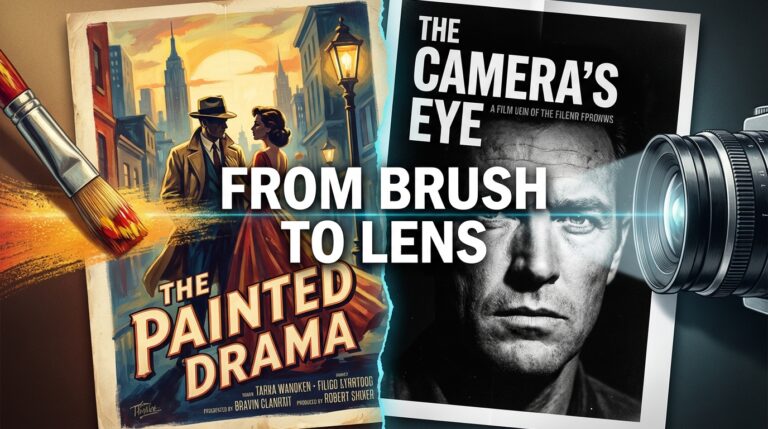
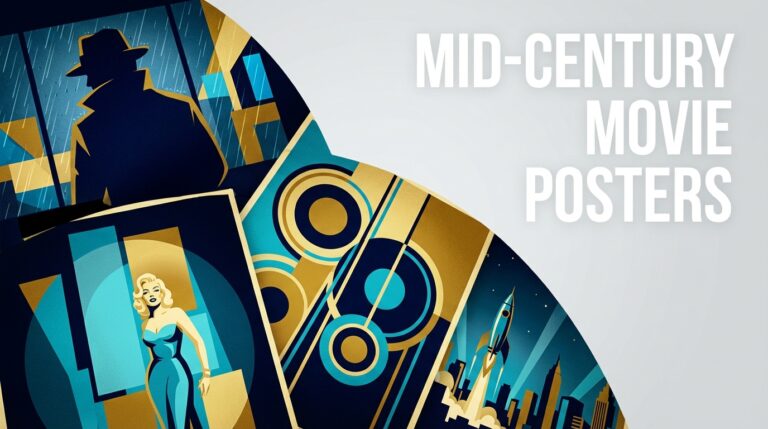
Mid-century modern (MCM) movie posters marked a revolution in visual culture. Where 1930s-40s posters depended on lush star portraits and literal scenes, the 1945-1970 period brought pure abstraction, minimal color, and inventive typography. This visual language reflected postwar optimism, technological leaps like offset lithography, and a new generation of directors demanding that posters evoke themes, not simply sell faces.
Design DNA:
“Less is more”—a Bauhaus mantra—became the guiding principle. Think bold geometric forms, two to four color palettes, and typography that acted as structure, not ornament. Saul Bass, for example, distilled addiction into one jagged arm for The Man with the Golden Arm; his Vertigo spiral told the whole story with just three colors and hypnotic lines.
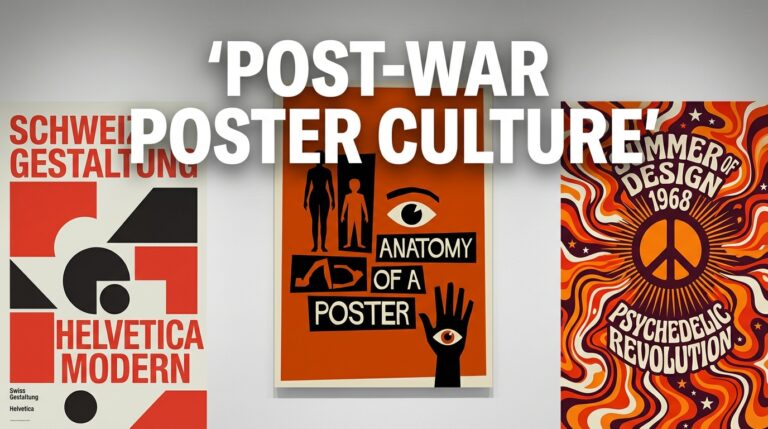
Typography evolved too. Out went decorative scripts, in came sans-serifs like Helvetica and Univers—sturdy, legible, and uncompromisingly modern. The color was used sparingly: one bold tone for psychological punch, set against black, white, or muted ground. The effect? Maximum impact with minimum ingredients.
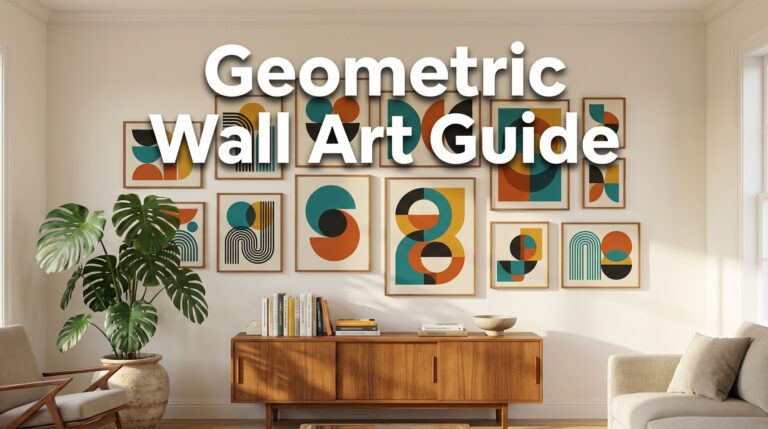
For a deeper look at how MCM poster principles translate into interiors, check out this wall art guide.
Evolution Timeline:
- 1940s—Propaganda and Golden Age: Painted likenesses, full color, decorative typography.
- 1950s—Begin MCM: Geometry, abstraction, minimalism, bold type. Saul Bass and the Swiss Style enter the scene. See also this geometric design guide.
- 1960s—International Innovation: Italian color blocking, French New Wave hand-drawn type, Japanese calligraphic minimalism, American psychedelia enters late decade.
- 1970s—Blockbuster Minimalism: Posters like Jaws still evoke MCM principles in stark simplicity, even as airbrushed realism returns by the end of the decade.
| Era | Design Style | Typography | Color Palette | Notable Examples | Collectibility Factor |
|---|---|---|---|---|---|
| 1930s-40s | Painted, literal | Serif, script | 8–10 hues | Gone with the Wind, Casablanca | High (rarity & nostalgia) |
| 1950s | Geometric, abstract | Sans-serif | 2–4 colors | Bass’s Hitchcock posters | Very high (design revolution) |
| 1960s | Photomontage, experimental | Hand-drawn, integrated | Primaries, earth tones | 2001: A Space Odyssey, Blow-Up | Very high |
| 1970s | Minimalist blockbusters | Clean commercial sans-serif | Monochrome drama | Jaws, Star Wars (early) | High (transitional) |
Posters from the 1950s-60s consistently bring the highest prices—they’re both art historical and pop culture landmarks. For spatial inspiration, see this wall art curation source.
The Saul Bass Revolution – How One Designer Redefined Cinema Art
Saul Bass (1920–1996) is the single most important figure in mid-century movie poster design. Trained on modernist principles, Bass approached the poster as a conceptual icon: “Symbolize and summarize. Design is thinking made visual.” His genius was translating narrative themes into audacious reductionism—jagged hands, spirals, negative-space bodies that linger in the memory longer than any celebrity face.
Design Hallmarks:
- Hand-cut geometric shapes and asymmetrical balance
- Negative space creates psychological tension
- Typography as architecture, not ornament (Futura, Akzidenz-Grotesk)
- Maximum 2–3 colors per poster; red for danger, black for mystery, blue for cool detachment
“The essence of good design is clarity and simplicity.” —Saul Bass
Iconic Works (and what to look for):
- The Man with the Golden Arm (1955): Jagged white arm, pure black field; no images of Frank Sinatra—just a geometric symbol. Heritage Auctions: $8,000–$12,000 (C8 originals).
- Vertigo (1958): Concentric spiral in black, white, and pink, encapsulating narrative obsession. Sold for $26,400 (C8.5, 2018).
- Anatomy of a Murder (1959): Fragmented body parts, typography mirroring the illustration’s fracture. Value: $3,500–$5,000 (C7 originals).
- West Side Story (1961): Negative-space dancers, red–orange gradients. Bass shaped the visual identity even when not the direct poster artist.
- The Shining (1980): Late-career minimalism, using just yellow type for terror.
Why Collectors Obsess: Bass’s originals are investment-grade, blue-chip art objects.
- Hitchcock posters: $5,000–$50,000+
- Preminger/demi-prestige: $1,500–$8,000
- Late career: $800–$3,000
Authentication is a must—counterfeits abound. Originals show stone lithograph dot patterns, period paper, and correct NSS codes. For affordable, style-faithful prints or starter investments, browse the Bebidas.
Studio House Styles – Warner Bros., United Artists & International Cinema
Each major studio cultivated its own “house style,” reflected in both subject matter and layout:
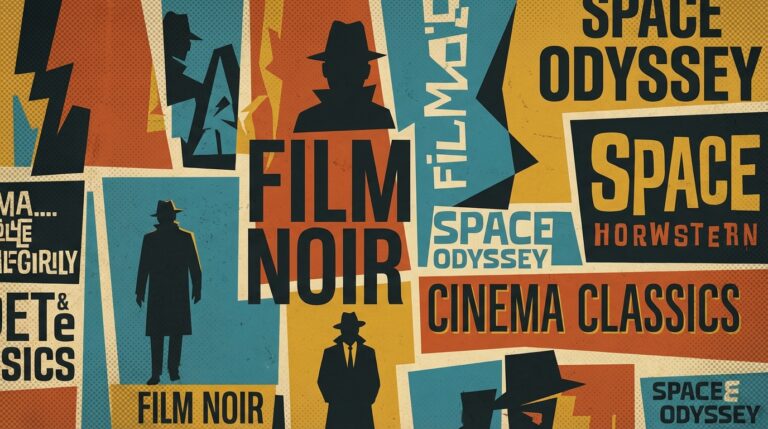
- Warner Bros.—Film noir heaviness, shadowy urban images, geometric type. Even 1960s reissues like The Maltese Falcon update art deco with MCM cleanliness.
- United Artists—The “director’s studio.” Gave Saul Bass wide berth, resulting in the period’s most daring abstraction.
- MGM—Slow transition: 1950s posters still headline stars, but by the 1960s, minimalist art appears especially for art-house releases.
International DNA:
French New Wave designers deployed hand-drawn typography; Italian posters for 8½ and Antonioni pieces are the heart of Surrealist photomontage. Japanese posters fuse negative space and calligraphy, often in B2 format (20×29″, perfect for smaller spaces).
- French “grande” posters (47×63″) give maximal wall impact and can cost 30–60% less than U.S. one-sheets for similar design sophistication.
- Italian “fotobusta” (18×26″) sets are prized for integrated narrative series.
- Japanese posters emphasize minimalist calm, perfect for modern interiors.
Studio or printer codes (NSS numbers, union bugs) are keys to verifying authenticity (explained in the authentication section below). For more practical wall inspiration, browse the wall art guide.
How To Identify Authentic Mid-Century Modern Movie Posters – Basic Collecting Techniques For Beginners
Why it matters: $8,000 for a real one, $20–$50 for a fake—and eBay is filled with misrepresented reprints. Don’t get burned.
Six-Point Authentication System:
- Paper Quality & Aging: Originals use 28–32 lb. matte or semi-matte stock. Look for edge yellowing, paper fibers under 10x magnification, and gentle age softening. Repros feel bright white, crisp, and chemically uniform.
- Printing Method Examination: Use a 10x loupe. True 1945–60s lithographs show random, soft-edged ink dots (rosettes), and ink layers may be slightly misaligned. Digital repros have perfect grid dots and sharp, glossy color.
- Size Verification: U.S. One-Sheet = 27×41″. Inserts = 14×36″. Half-Sheet = 22×28″. 24×36″ is always a modern reprint. International sizes: French Grande = 47×63″, Italian Fotobusta = 18×26″, Japanese B2 = 20×29″.
- Dating Codes & Printers: NSS codes (e.g., 58/245 means 1958), union bugs, period printer stamps (Morgan Litho, Tooker). These often appear bottom right or left, sometimes margin area.
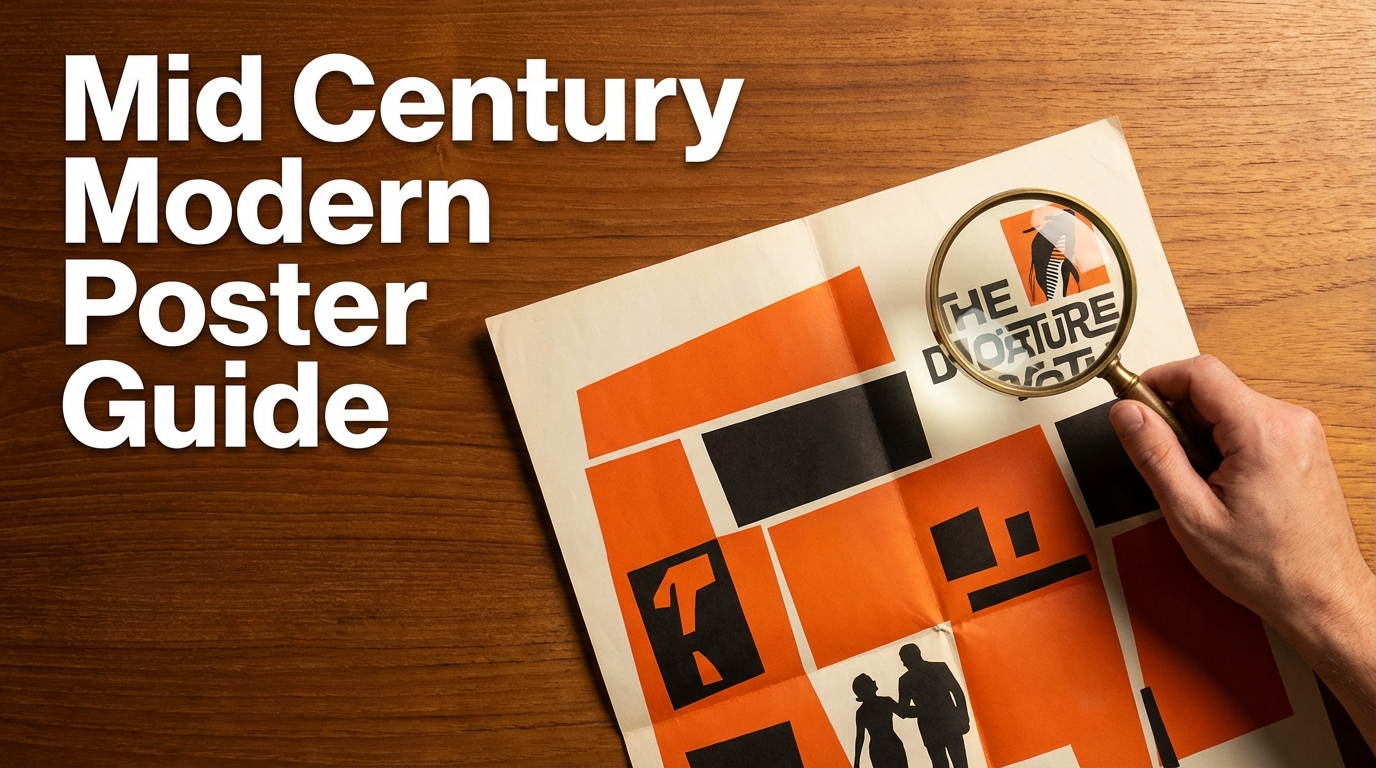
- Fold Patterns: Originals almost always folded in eighths (two horizontals, one vertical) for theater shipment—slight, aged crease lines are a good sign. Pristine unfolded “originals” should raise suspicion.
- Typography & Design Consistency: Wrong fonts (e.g., Helvetica instead of Univers), altered credits or colors, and over-cleaned repros signal fakes. Always compare with archival auction photos.
Classic beginner errors:
- Trusting “vintage” eBay labels without photo evidence
- Chasing 30–40 year old 1980s reprints as “authentic”—they’re not 1950s-60s originals
- Not measuring: if it’s not a theatrical size, walk away
- Confusing lobby cards (8×10″) with one-sheets (27×41″)
DO ask for extra photos—especially of edges, codes, and folds. Compare with auction catalogs, scrutinize every detail, and never buy on trust alone.
Where To Find Authentic Mid-Century Modern Movie Posters
Not all sources are equal. Here’s how to build safely, from zero to world class:
-
Auction Houses (Heritage, Christie’s, Sotheby’s):
- Confidence: 95–99% (expert-vetted)
- Range: $500–$50,000+
- Pro: 3rd-party grading, ironclad authenticity, investment-worthy
- Con: Buyer’s premiums (~20%), limited selection per sale
-
Specialist Dealers (T-Shirts, Posteritati):
- Confidence: 90-95% (curated, reputation at stake)
- Range: $200–$10,000
- Pro: Pre-authenticated, fixed price, returnable
- Con: Dealer markup, more limited range vs. eBay
For assured authenticity and educational support, browse the Kylpyhuonetarvikkeet at pilloleperaumentareilpene-it.
-
Poster Shows & Fairs (Hollywood Poster Fair, Vintage Paper Fair):
- Confidence: 80–90% (requires in-person inspection)
- Pro: See/feel paper & print, negotiate prices, network for future finds
- Con: Geographic/temporal limits, authentication knowledge required
-
Online Marketplaces (eBay, Etsy):
- Confidence: 30–70% (variable, must authenticate personally)
- Pro: Bargain potential, wide inventory
- Con: High misrepresentation risk; apply full six-point system
-
Estate Sales & Flea Markets:
- Confidence: 50–80% (hit or miss, requires deep inspection)
- Pro: Rare finds, low entry costs
- Con: Time intensive, poor condition more likely
| Source Type | Authenticity Confidence | Price Range | Best For | Risk Level | Time Investment |
|---|---|---|---|---|---|
| Auction Houses | 95-99% | $500-$50,000+ | Investment pieces | Low | Medium |
| Specialist Dealers | 90–95% | $200–$10,000 | Convenience/variety | Low | Low |
| Poster Shows | 80–90% | $100–$5,000 | Hands-on learning | Medium | Medium |
| Online Marketplaces | 30–70% | $50–$2,000 | Bargain hunting | High | High |
| Estate Sales | 50–80% | $25–$500 | Low entry/treasure | Medium | Very High |
Budget allocation tips:
- Beginner ($500–1,000): 70% specialist dealers, 20% online, 10% estate/flea
- Intermediate ($1,000–5,000): 50% auction/dealer, 30% poster shows, 20% online
- Advanced ($5,000+): 60% auctions, 30% dealer, 10% speculative
Advanced Techniques – Authentication, Grading, Restoration & Investment Strategies
Level up with forensic-level authentication, proper grading, and portfolio-building:
-
Microscopic & UV Paper Analysis:
1950s–60s posters contain rag fibers (visible at 100x); modern reproductions are chemically white with no aging under UV. Test with affordable UV flashlight—vintage glows dull purple, modern bright blue-white. -
Ink & Fading Assessment:
Run a faint fingernail test (bottom edge)—old inks powder slightly, toner will not. Authentic posters fade unevenly—solid color should show gradation if parts were exposed to sun. -
Printer Attribution:
Learn to recognize major printers’ quirks (Morgan Litho, Pacific Litho). Different dot patterns and ink densities are forensic telltales. -
Third-Party Grading/Appraisal:
For posters >$2,000, use PSA/DNA or CGC. Fees: $50–150.
These certificates add 10–20% value and serve for insurance/resale.
Condition Grading: C1–C10 Scale (every point counts!):
| Grade | Condition | Common Issues | Value Impact |
|---|---|---|---|
| C10 (Mint) | Perfection | None | +400–700% |
| C9 (Near Mint) | Minor handling/faint aging | Tiny edge wear, lightly aged folds | +200–400% |
| C8 (Excellent) | Normal age, clean display | Fold separations, faint stains | Base price x2–3 |
| C6–C7 (Very Good–Fine) | Wear, tears, yellowing | Repaired tears, tape shadows | −30–50% |
| C1–C5 (Poor–Good) | Missing corners/sections, major tears | Heavy staining, lost graphics | −75% or more |
Linen backing (mounting on linen for support/repair) does not destroy value—often improves presentation for C5–C8 range, but always declare this on resale.
Investment Tips:
- Diversify: One major title, two “A minus” titles, three international alternates
- Authenticate and grade before investing above $2,000
- Track market via auction catalogs (Heritage, Christie’s past sales)
- Store flat or rolled, out of sunlight, ideally in Mylar, acid-free folders, and climate control (60–70°F, 40% RH)
FAQ
Use the six-point system: inspect paper, printing, size, codes, folds, and typography. Compare every detail with reference images from reputable auctioneers. When in doubt, have a professional appraiser review it.
What is the most valuable mid-century modern movie poster?
Saul Bass’s Vertigo (1958) U.S. one-sheet. A near-mint example sold for $26,400 in 2018; rare, iconic titles can crack $50,000+ in exceptional condition.
Are linen-backed posters still considered “original”?
Yes, if the underlying poster is original. Professionally linen backing for conservation is accepted and can even improve value for worn pieces, but must be disclosed.
Is it worth collecting high-quality reprints?
For visual display and education—yes. As investment—no. Only authentic 1945–70s prints hold and grow value.
Where should I start if my budget is under $1,000?
Focus on authenticated, lesser-known but high-design posters via specialist dealers like Pyyhekuivaimet, or international alternates. Avoid eBay unless you authenticate using all methods above.
How should I preserve and frame my collection?
Always use UV-filtering museum glass, acid-free backings, and store in dark, climate-controlled environments. Avoid tape and adhesives; use Mylar sleeves or archival folders for unframed storage.